Review: Hegel (Frederick Beiser) — the study that holds the system together
★★★★☆4.3 / 5.0 (editorial rating)
Verdict: once you have actually read Hegel, read this to hold it together. Beiser — one of the leading historians of German Idealism — sets the whole system (metaphysics, logic, politics, history) back in Hegel's own time and his own problems, and dismantles the caricatures that dog him: the sham "thesis-antithesis-synthesis," the cartoon apologist for the Prussian state. It is not an entry point and does not pretend to be. It is the single-volume scholarly study that consolidates everything the primary texts opened up.
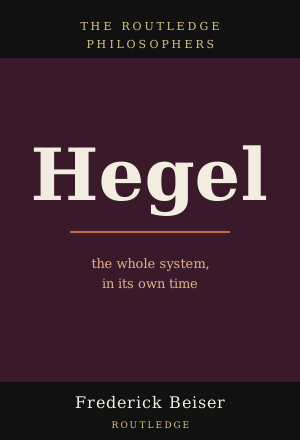
- Title
- Hegel (The Routledge Philosophers)
- Author
- Frederick Beiser (historian of German Idealism)
- Publisher
- Routledge (2005)
- Length
- ~364 pp.
- Difficulty
- Advanced ★★★ — a scholarly study; read it after the primary texts, not before
Check price & availability on the Amazon product page
What it is — in three lines
A single-author scholarly study of Hegel by Frederick Beiser, in Routledge's The Routledge Philosophers series. Rather than paraphrase one work, it takes on the whole system — the early theological writings, the metaphysics and the Logic, the philosophy of nature, ethics and politics, and the philosophy of history — and reads it back into the intellectual world that produced it. Beiser's governing move is historical: recover the actual problems Hegel was answering, and the "mystical" or "absurd" Hegel of caricature dissolves. A book for after the primary texts, not before.
The core — Hegel in his own time
Beiser's central argument is that Hegel becomes intelligible only when you stop reading him through later slogans and put him back among his contemporaries and their questions — the aftermath of Kant, the crisis over faith and reason, the problem of a divided modern life. Do that, and the notorious doctrines look less like mysticism and more like reasoned responses to real difficulties. He is especially good at clearing away two myths at once: that Hegel's method is the mechanical triad of "thesis-antithesis-synthesis," and that the Philosophy of Right is mere apology for the Prussian state.
Read Hegel through later slogans and he looks like a mystic; read him back into the problems of his own age and the same doctrines become reasoned answers. (an editorial summary of the book's approach)
— the guiding method of Beiser's Hegel (editorial gloss)
The result is not an easier Hegel but a more defensible one — the system shown as a connected response to a moment, which is exactly what a reader who has met the parts needs in order to see the whole.
Three highlights
1. It pulls the parts into a whole
After the introduction, the lectures, and two masterpieces, you hold pieces; Beiser connects them — logic to politics to history — so "the truth is the whole" becomes something you can actually see laid out.
2. It clears away the caricatures
The bogus triad and the "state-worship" charge are met head-on and answered from the texts and the history. You come away able to say what Hegel did and did not hold.
3. Scholarship you can trust, in one volume
Beiser is a major historian of the period, and the book carries that authority while staying within a single, navigable volume — the standard recommendation when a reader wants one serious study rather than a shelf of monographs.
What to watch out for
Two honest notes. First, this is not a first book, and not a substitute for the primary texts. Its arguments assume you have at least met the Phenomenology and the Philosophy of Right; open it cold and the debates it settles will not yet be debates you feel. Read Hegel first, this after. Second, it is a reading — Beiser's historical, anti-metaphysical-caricature Hegel is an interpretation, and other scholars weight the metaphysics or the logic differently. Take it as a strong, well-argued position to think with, not the last word.
Check price & availability on the Amazon product page