Home › Top 5 › Very Short Introduction
Review: Hegel: A Very Short Introduction — the map to hold before the masterpiece
★★★★★4.6 / 5.0 (editorial rating)
Verdict: if you read one book before you touch Hegel's own, read this. Singer takes the reputation for impossibility head-on and, in about a hundred and thirty pages, gives firm outlines to the words that trip everyone up — dialectic, spirit (Geist), freedom, history — without retreating into the "thesis-antithesis-synthesis" slogan. Get this map, and the lectures and masterpieces that follow become startlingly more readable.
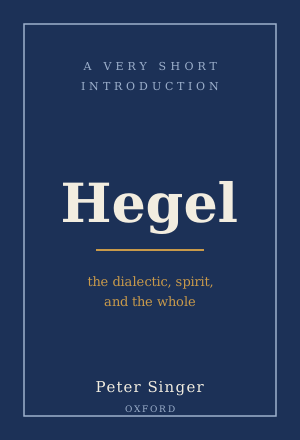
- Title
- Hegel: A Very Short Introduction
- Author
- Peter Singer (moral philosopher; author of the earlier Hegel in OUP's Past Masters)
- Publisher
- Oxford University Press (Very Short Introductions)
- Length
- ~131 pp.
- Difficulty
- Beginner ★☆☆ — about four hours; the book to read before the primary texts
Check price & availability on the Amazon product page
What it is — in three lines
A short introduction to Hegel by Peter Singer, in Oxford's Very Short Introductions series (based on his longer Hegel for the Past Masters series). It is not a paraphrase of any one work but a working map of the whole: why Hegel thought as he did, and what the dialectic, spirit, freedom, and history actually mean in his hands. Short — but a genuine introduction, written to send you into the primary texts able to read them.
The core — a map for the key words
The reason beginners find Hegel impossible is that his key words all slide away from their everyday senses. Singer's central service is to give each of them a map. The dialectic is not a mechanical formula but a movement: something carries a contradiction within itself and, by passing through it, develops into a higher stage. The popular "thesis, antithesis, synthesis" is a later label — and, Singer notes, not Hegel's own phrasing; what matters is sublation (Aufhebung), in which a stage is negated and yet preserved at a higher level. Spirit (Geist), likewise, is not a private mind but the movement by which we come to know what we are through others, society, and history.
The dialectic is no magic that makes conflict vanish. A stage is negated and, at the same time, preserved at a higher level — this sublation is the heart of Hegel's movement. (an editorial summary of the book's account)
— the guiding picture of Hegel: A Very Short Introduction (editorial gloss)
Because Singer ties these terms to concrete examples and to the history of ideas, the abstractions never float free: you keep the sense of why Hegel needed each concept.
Three highlights
1. It frees you from the "thesis-antithesis-synthesis" reflex
Most people stall at Hegel-equals-triads. Singer shows how the slogan actually blocks understanding, and puts the dialectic back as a movement. Once that lands, the way you read the primary texts changes at the root.
2. Freedom and history as the living centre
Singer treats Hegel not as a museum piece but as a thinker about freedom and history whose questions are still live. That focus gives a first reader a reason to keep going — and previews the argument of the lectures on history.
3. A trusted guide, plainly written
Singer is a philosopher of the first rank writing for beginners, and it shows: the prose is clear without being thin. It is the rare short book on Hegel that never buys simplicity with distortion.
What to watch out for
Two honest notes. First, it is an introduction, not the thing itself. Singer gives you the map; he does not — and cannot, in this space — walk every road of the Phenomenology or the Logic. Treat it as scaffolding to be replaced by the primary texts, not as "Hegel, done." Second, any hundred-page Hegel involves choices, and Singer's emphases (freedom, history, the social self) are his own reading; other guides weight the metaphysics or the logic more heavily. That is a reason to read Beiser's fuller study later, not a flaw in a first book.
Check price & availability on the Amazon product page