HEART SUTRA BOOK GUIDE
The 5 Best Heart Sutra Books (2026)
— from an accessible translation to a comprehensive guide, in reading order
A single page, a few hundred syllables — the most chanted, copied, and memorised scripture in Mahayana Buddhism. And yet the moment you try to understand it, you stall on one line: "form is emptiness, emptiness is form." That is the Heart Sutra. At its centre is emptiness (śūnyatā) — the view that nothing holds a fixed, independent self-nature, that everything arises and changes in relationship. This page is where you choose the first book that will actually carry you through those few lines. Get an accessible translation with commentary, then a teacher's practice reading, then a comprehensive scholarly guide, and finally a modern reinterpretation — five books, with a difficulty table and a step-by-step reading order.
The editorial room behind this site runs a family of bookshelves on philosophy and Buddhist thought, and chooses every title on the same principle: the right first book is the one you finish. If, after the Heart Sutra, you want to widen out toward philosophy in general, the umbrella Philosophy Bookshelf takes it from here.
Our RankingRANKING
The editorial order. If you can't decide, start at #1. Check prices and availability on the Amazon product pages. Every title here is currently in print from an established Buddhist or trade publisher.
-
1
 If in doubt, start hereIntermediateTranslation + commentary
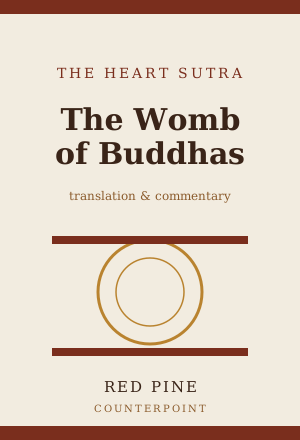
The Heart Sutra: The Womb of Buddhas
The single best entry point in English: a clear, complete translation broken into short lines, each unpacked with commentary that draws on a millennium of Chinese and Sanskrit sources. Red Pine gives you both the map and the terrain — the whole sutra, and a guided walk through every phrase, without ever losing the general reader.
Check price & availability on Amazon
View on Amazon Read our review -
2
 BeginnerPractice commentary
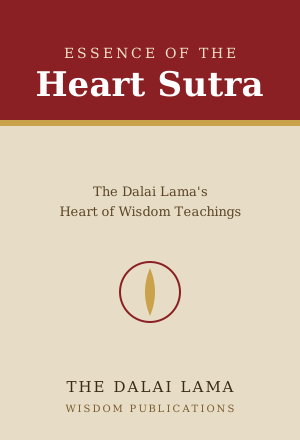
Essence of the Heart Sutra: The Dalai Lama's Heart of Wisdom Teachings
Drawn from public teachings, this is the warm, practice-oriented reading: the Dalai Lama sets the sutra inside an easy-to-follow overview of Buddhist philosophy, so emptiness arrives as something to live rather than a puzzle to solve. Thupten Jinpa's editing keeps it grounded. The natural second step after the translation.
Check price & availability on Amazon / Kindle edition available
View on Amazon Read on Kindle Read our review -
3
 AdvancedScholarly guide
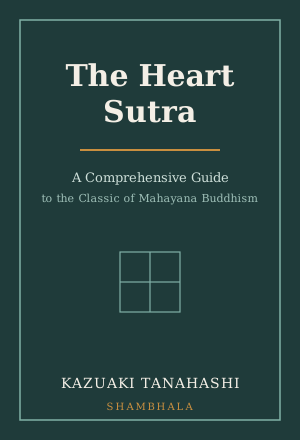
The Heart Sutra: A Comprehensive Guide to the Classic of Mahayana Buddhism
Once the meaning is in place, this is the scholar-practitioner's deep dive: the history of the text, a fresh translation, and a line-by-line analysis across Sanskrit, Chinese, Japanese, Korean, Tibetan and Mongolian versions. The reference volume of the shelf — the place to go when you want to know exactly how each word was chosen.
Check price & availability on Amazon / Kindle edition available
View on Amazon Read on Kindle Read our review -
4
 BeginnerShort exploration
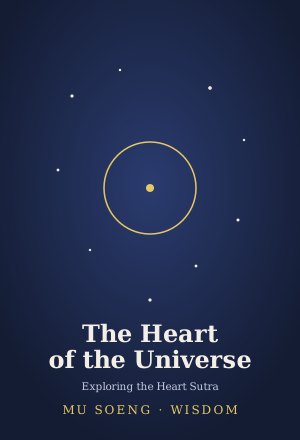
The Heart of the Universe: Exploring the Heart Sutra
A short, readable exploration from a former Zen monk and Buddhist-studies scholar. Soeng walks the sutra from historical, spiritual and even scientific angles, with a light touch and a slim page count. The most approachable prose here — a gentle way in, or a palate-cleanser between the heavier volumes.
Check price & availability on Amazon / Kindle edition available
View on Amazon Read on Kindle Read our review -
5
 IntermediateModern reading
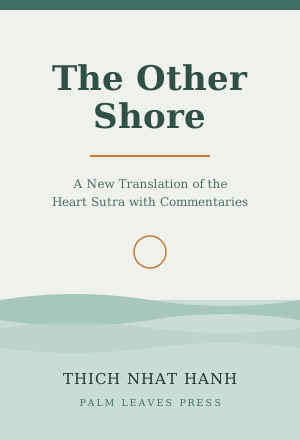
The Other Shore: A New Translation of the Heart Sutra with Commentaries
The world-renowned Vietnamese Zen teacher re-reads the sutra through his own term, "interbeing" — emptiness not as void but as the fact that everything exists only in relationship. This new translation deliberately re-words the classic to head off the "emptiness = nothingness" misreading. The modern reinterpretation to finish on, once the traditional footing is set.
Check price & availability on Amazon / Kindle edition available
View on Amazon Read on Kindle Read our review
The 5 Books at a GlanceCOMPARE
The biggest worry with the Heart Sutra is "it's so short — will I stall if I jump straight into the text?" Choose by difficulty and by what each book is for.
| Title | Difficulty | Length | Type | Best for | Links |
|---|---|---|---|---|---|
| The Heart Sutra: The Womb of BuddhasRed Pine · Counterpoint | Intermediate ★★☆ | ~208 pp. ~5 hrs |
Translation + commentary | You want the whole sutra and a guided walk through every line | View on Amazon Review |
| Essence of the Heart SutraThe Dalai Lama, tr. Thupten Jinpa · Wisdom | Beginner ★☆☆ | ~180 pp. ~4 hrs |
Practice commentary | You want emptiness set inside a warm overview of Buddhist thought | View on Amazon Review |
| The Heart Sutra: A Comprehensive GuideKazuaki Tanahashi · Shambhala | Advanced ★★★ | ~288 pp. 1–2 weeks |
Scholarly guide | You want the history and a line-by-line analysis across languages | View on Amazon Review |
| The Heart of the UniverseMu Soeng · Wisdom | Beginner ★☆☆ | ~192 pp. ~4 hrs |
Short exploration | You want the most approachable prose, a gentle way in | View on Amazon Review |
| The Other ShoreThich Nhat Hanh · Palm Leaves Press | Intermediate ★★☆ | ~138 pp. ~3 hrs |
Modern translation + commentary | You want emptiness re-read as "interbeing," a contemporary voice | View on Amazon Review |
A Reading Order That Won't Defeat YouROADMAP
People stall on the Heart Sutra for almost one reason only: they trust its shortness and jump straight into the bare text. Because so much meaning is compressed into a few lines, "form is emptiness" freezes you unless you already carry the background. Get the translation and the map first, deepen it with a teaching and the scholarship, and only then reach for a modern reinterpretation. Climb in four steps.
-
STEP 1 ── Get the map (one book)
Read Red Pine's translation and commentary
Start with The Heart Sutra: The Womb of Buddhas. One volume gives you a clear translation of the whole sutra plus a line-by-line commentary — so the phrases that read like code start to carry meaning. With this map in hand, every later book gets easier.
Red Pine's Heart Sutra on Amazon -
STEP 2 ── Deepen it (books 2 & 4)
A teacher's reading, then a short exploration
Now let the meaning settle. The Dalai Lama's Essence of the Heart Sutra places emptiness inside a warm overview of Buddhist philosophy, and Mu Soeng's The Heart of the Universe is a short, approachable exploration you can read in an afternoon. Either — or both — turns the translation into something felt, not just parsed.
Essence of the Heart Sutra on AmazonThe Heart of the Universe on Amazon -
STEP 3 ── Go to the source-level detail (book 3)
Work through Tanahashi's comprehensive guide
When you want to know exactly how the words were built, turn to Kazuaki Tanahashi's Comprehensive Guide. Its line-by-line analysis across Sanskrit, Chinese, Japanese, Korean, Tibetan and Mongolian versions is the hard climb of the shelf — but with the earlier books as footing, every note lands.
Tanahashi's Comprehensive Guide on Amazon -
The goal ── A modern reinterpretation
Finish with Thich Nhat Hanh's "interbeing" reading
With the traditional footing set, go further. Thich Nhat Hanh's The Other Shore re-reads emptiness as "interbeing" — everything existing only in relationship, never in isolation. His new translation deliberately re-words the classic so that emptiness reads as fullness of connection, not void. A contemporary voice to close on. If you then want to widen out toward philosophy in general, the umbrella Philosophy Bookshelf takes over.
The Other Shore on Amazon
How We ChoseCRITERIA
Four criteria. First, currently in print and actually available on amazon.com — every title has a live product page from an established publisher (Counterpoint, Wisdom, Shambhala, Palm Leaves Press). Second, the ladder must hold: accessible translation → practice reading → comprehensive guide → short exploration → modern reinterpretation, each step preparing the next, with entry points at every height from a slim exploration to a fully cross-lingual analysis. Third, honesty about what each book is — a translation with commentary, a teacher's talks, a scholar's reference volume, or one master's personal re-reading — and the reviews say which. Fourth, because this English shelf mirrors a Japanese-language one built largely on Japanese commentaries, we substituted the closest respected English works on the same roles (only Thich Nhat Hanh's Heart Sutra book appears in both editions); the About page spells out those substitutions. Difficulty and star ratings are the editorial room's own — not reproductions of Amazon reviews — and explanations of the sutra's key terms (emptiness, form-is-emptiness, prajñā, pāramitā) are given in our own words from general knowledge, without reproducing any translation under review.
Still Undecided? Take This OneCONCLUSION
If you have read this far and still can't choose, the answer is simple: start with Red Pine's The Heart Sutra: The Womb of Buddhas. One paperback gives you the whole sutra in a clear translation and a patient, phrase-by-phrase commentary — the least likely way to stall. With that footing, the Dalai Lama's teaching, Tanahashi's guide, and Thich Nhat Hanh's modern reading all become your allies.
Check price & availability on the Amazon product pages