Home › Top 5 › The Heart of the Universe
Review: The Heart of the Universe — the short, approachable way in
★★★★☆4.1 / 5.0 (editorial rating)
Verdict: the gentlest, most approachable prose on the shelf. In a slim volume, Mu Soeng — a former Zen monk and a scholar of Buddhist studies — explores the Heart Sutra from historical, spiritual and even scientific angles, with a light, essayistic touch. Read it as a soft way in, or as a palate-cleanser between the heavier books. It asks little and gives a clear, humane feel for what the sutra is doing.
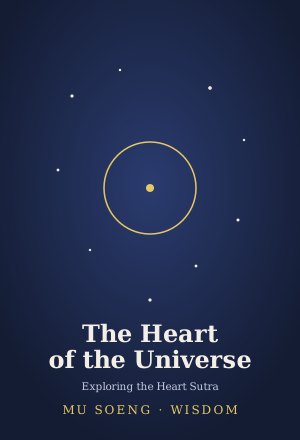
- Title
- The Heart of the Universe: Exploring the Heart Sutra
- Author
- Mu Soeng
- Publisher
- Wisdom Publications
- Length
- Short exploration · ~192 pp.
- Difficulty
- Beginner ★☆☆ — light, essayistic, easy to finish
Check price & availability on the Amazon product page
What it is — in three lines
Mu Soeng is a former Zen monk who became a scholar-in-residence at a centre for Buddhist studies and has written widely on Buddhism, including a companion volume on the Diamond Sutra. The Heart of the Universe is a short book that walks around the Heart Sutra rather than annotating it line by line, drawing on its history, its place in meditative practice, and — distinctively — resonances readers have found with modern physics and cognitive science. It is exploratory and personal, closer to a set of connected essays than a formal commentary.
Emptiness from several angles
The book's appeal is its angle of approach. Where a translation fixes the text and a scholarly guide dissects it, Soeng circles it, asking what emptiness looks like from different vantage points. The move that catches most readers is his willingness to put the sutra's account of a world without fixed, independent things next to the picture that emerges from modern science — not to prove that ancient Buddhists anticipated physics, but to loosen the intuition that reality is made of solid, separate objects. Handled carefully, as it is here, this is a genuinely useful way to make "no fixed self-nature" feel less abstract.
Because the tone is unforced and the chapters are short, the book is easy to absorb. It does not try to be the last word; it tries to open a door, and it does.
Three highlights
1. Brevity and readability
It is short and unintimidating — the kind of book you can finish over a weekend and come away genuinely oriented. For a reader wary of dense scripture, that matters.
2. The science-and-emptiness conversation
The bridge to physics and cognitive science is handled as suggestion, not proof, and it gives the abstract idea of emptiness a concrete foothold in a modern reader's world.
3. A practitioner-scholar's balance
Soeng writes from both the cushion and the study, so the book stays warm without going soft, and informed without going technical.
What to watch out for
Two honest notes. First, the very lightness that makes the book so approachable means it is an exploration, not a systematic commentary: do not come to it for a rigorous, phrase-by-phrase account — that is Tanahashi's and Red Pine's job. Second, the science material is best read as evocative analogy rather than literal equivalence; the parallels between emptiness and physics are illuminating metaphors, and the book is at its strongest when you take them that way. Placed as a gentle fourth reading — or as an easy first taste before the heavier volumes — it earns its spot.
Check price & availability on the Amazon product page