Home › Top 5 › The Heart Sutra: A Comprehensive Guide
Review: The Heart Sutra — A Comprehensive Guide — the reference volume
★★★★☆4.3 / 5.0 (editorial rating)
Verdict: the deepest single book on the shelf, and the one to reach for when you want to know exactly how each word was chosen. Tanahashi — a calligrapher, translator and lifelong student of the text — gives you the history, a fresh translation with Roshi Joan Halifax, and a line-by-line analysis across Sanskrit, Chinese, Japanese, Korean, Tibetan and Mongolian versions. A demanding, rewarding reference. Not a first book; a superb third one.
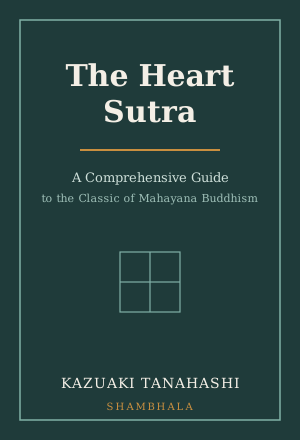
- Title
- The Heart Sutra: A Comprehensive Guide to the Classic of Mahayana Buddhism
- Author
- Kazuaki Tanahashi (with a foreword by Roshi Joan Halifax)
- Publisher
- Shambhala
- Length
- Scholarly guide · ~288 pp.
- Difficulty
- Advanced ★★★ — cross-lingual detail; best read slowly
Check price & availability on the Amazon product page
What it is — in three lines
Kazuaki Tanahashi is a Japanese-born calligrapher and translator known for his work on Dōgen and other classics of Zen. This book is the fruit of a lifetime with the Heart Sutra: it opens with the text's history and transmission, offers a new translation made with the Zen teacher Roshi Joan Halifax, and then works through the sutra line by line, comparing how it reads in Sanskrit, Chinese, Japanese, Korean, Tibetan, Mongolian and several key English versions. It is the closest thing on this shelf to a one-volume reference.
Why the cross-lingual method matters
The Heart Sutra did not come to us in one language. It was composed in — or translated into — Sanskrit, carried into Chinese by translators such as Xuanzang, and from there into the whole of East Asia and Tibet. Tanahashi's method takes that history seriously: by laying the versions side by side, he shows where a single term forks into different meanings, where a translator made a choice, and where the familiar English hides a decision. This is how you discover that "emptiness," "form," and even the sutra's title carry more freight than any one rendering can hold. For a reader who has already grasped the general meaning, this comparative detail is where the text suddenly deepens.
Tanahashi writes as a practitioner as well as a scholar, so the philology never becomes an end in itself — it always circles back to what the line is actually saying and why it might matter for a life. That balance is the book's signature.
Three highlights
1. The comparative, line-by-line analysis
Seeing the same line in several languages at once is genuinely illuminating; it turns "the translation says X" into "here is the range the original allows." No other book on this shelf does it at this depth.
2. History and transmission up front
The opening chapters on where the sutra came from and how it travelled give you the scaffolding most short treatments skip. You leave knowing the text's biography, not just its meaning.
3. A translator-calligrapher's care for the word
Tanahashi's attention to each character — its shape, its history, its resonance — brings a tactile quality to the analysis that a purely academic study would miss.
What to watch out for
One clear caution: this is not a starting point. The cross-lingual apparatus that makes the book valuable also makes it dense, and a newcomer can drown in variant readings before the sutra's basic sense has landed. Read it after an accessible translation such as Red Pine's and a framing teaching such as the Dalai Lama's, and the same detail that would have overwhelmed you becomes fascinating. Treat it as a reference to move through in sections rather than a book to race through cover to cover; you will return to it for years.
Check price & availability on the Amazon product page