Home › Top 5 › The Heart Sutra: The Womb of Buddhas
Review: The Heart Sutra — The Womb of Buddhas — the best way in
★★★★★4.6 / 5.0 (editorial rating)
Verdict: the first book on the Heart Sutra, with very little to argue about. One volume gives you the whole sutra in a clear translation and a patient, line-by-line commentary — so the phrases that first read like code slowly start to mean something. Red Pine is among the most respected translators of Chinese religious texts, and it shows: rigorous, generous, and never over the reader's head.
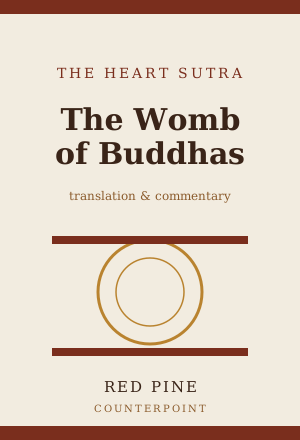
- Title
- The Heart Sutra: The Womb of Buddhas
- Author
- Red Pine (Bill Porter)
- Publisher
- Counterpoint
- Length
- Translation + commentary · ~208 pp.
- Difficulty
- Intermediate ★★☆ — accessible prose, but it does go term by term
Check price & availability on the Amazon product page
What it is — in three lines
Red Pine — the pen name of Bill Porter — is one of the most widely respected English translators of Chinese poetry and Buddhist texts. This book takes the Heart Sutra, the compact heart of the vast Prajñāpāramitā ("perfection of wisdom") literature, and presents a fresh translation broken into short numbered lines. Each line is then opened up with commentary that draws on Sanskrit originals, the Chinese versions, and the readings of dozens of earlier teachers. It is at once a translation, a study aid, and a guided tour — designed so you can read straight through or dwell on a single phrase.
Why it can be your first book
The reason is the structure. Emptiness is hard not because the words are long but because they are dense; the sutra says enormous things in almost no space. Red Pine's answer is to slow the text down to one line at a time and give each its own patch of ground. So "form is emptiness, emptiness is form" is not left hanging as a koan — it arrives with its history, its grammar, and its point. You get the general shape of the whole sutra and the detail of every phrase in a single pass, which is a rare combination for a first book.
Just as valuable is his tone. He is a scholar who wears the learning lightly, tells you when the sources disagree, and does not dress interpretation up as certainty. That honesty is exactly what a newcomer needs: a guide who shows the map and marks where the map runs out.
Three highlights
1. The line-by-line format
Splitting the sutra into short, chantable lines and commenting on each turns an intimidating block of scripture into something you can actually work through. You can read one line a day and never lose the thread.
2. Depth of sources
The commentary reaches back through the Chinese commentarial tradition and the Sanskrit, so behind the plain English sits a genuine weight of scholarship. You are not getting one man's opinion but a distillation of centuries.
3. A translator's ear
Red Pine's renderings read cleanly and memorably. For a text meant to be recited, that musicality matters — it is a translation you would be happy to sit with, not merely consult.
What to watch out for
Two honest notes. First, this is a translation-with-commentary, not a "philosophy of emptiness" primer: it explains the sutra superbly but assumes you want to meet the text itself rather than read around it. If you would rather have emptiness set inside a broader overview of Buddhist thought first, the Dalai Lama's Essence of the Heart Sutra plays that role. Second, the commentary does engage the Sanskrit and the Chinese, so a few stretches are more technical than the average trade paperback — feel free to skim the philological notes on a first pass and return to them later. Neither is a flaw; both are simply the shape of the book.
Check price & availability on the Amazon product page