Home › Top 5 › The Other Shore
Review: The Other Shore — emptiness re-read as "interbeing"
★★★★☆4.2 / 5.0 (editorial rating)
Verdict: the modern reinterpretation to finish on. The world-renowned Vietnamese Zen teacher Thich Nhat Hanh re-reads the Heart Sutra through his own term, "interbeing" — emptiness not as void but as the fact that nothing exists in isolation. He even offers a new translation that deliberately re-words the classic to stop readers hearing "emptiness" as "nothingness." Clear, warm, and distinctive — best read once the traditional footing is in place.
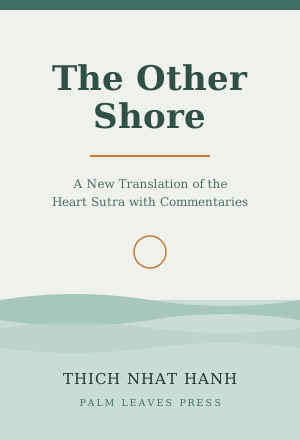
- Title
- The Other Shore: A New Translation of the Heart Sutra with Commentaries
- Author
- Thich Nhat Hanh
- Publisher
- Palm Leaves Press
- Length
- Modern translation + commentary · ~138 pp.
- Difficulty
- Intermediate ★★☆ — plain prose, but strongest with prior grounding
Check price & availability on the Amazon product page
What it is — in three lines
Thich Nhat Hanh, the Vietnamese Zen master who did more than almost anyone to bring mindfulness to a global audience, here reads the Heart Sutra in his own voice — and, unusually, provides a new translation of the text alongside his commentaries. His stated reason for the retranslation is bold: he judged that the wording of the received version could mislead readers into hearing the sutra as a denial of existence, and he set out to phrase it so that its meaning cannot be mistaken for nihilism. The result is a short, plain-spoken book from a distinctly contemporary and practice-centred Buddhism — the natural English counterpart to the Thich Nhat Hanh volume on the Japanese-language shelf this site mirrors.
"Interbeing" — emptiness as connection
At the centre is "interbeing," Thich Nhat Hanh's coined term for what emptiness points to: nothing stands alone; everything exists only in and through its relationships with everything else. His famous image is a sheet of paper that "inter-is" with the cloud, the rain, the sun and the logger's hands that made it possible — so the paper is made entirely of "non-paper elements." That is "form is emptiness" rendered for a modern ear. Where a reader might hear emptiness as bleak, he flips it into an affirmation: to be empty is to be full of everything else. This re-reading is the book's chief gift, and it dissolves the most common misunderstanding the sutra provokes.
As you would expect from a teacher of mindfulness, he does not want the idea to stay in the head; the commentary keeps returning it to breath, attention and daily life.
Three highlights
1. Emptiness turned into affirmation
Recasting emptiness as connection rather than absence clears away the "emptiness = meaninglessness" reading that trips up so many newcomers. It is a genuinely clarifying move.
2. The power of the concrete image
Paper, clouds, flowers — everyday pictures carry the abstract point without a single technical term. They are memorable, and they teach.
3. A global, contemporary voice
This is the Heart Sutra from modern engaged Buddhism, a different flavour from the classical commentaries, and it widens your sense of how the text can be received.
What to watch out for
One honest note that explains its place at the end of the roadmap. Because the book leans on the author's own vocabulary and deliberately departs from the traditional wording, using it as your very first encounter can blur the line between "the general understanding of the Heart Sutra" and "Thich Nhat Hanh's particular reading." Build the traditional footing first — an accessible translation like Red Pine's, a framing teaching like the Dalai Lama's, ideally the cross-lingual detail in Tanahashi — and his reinterpretation becomes far richer, because you can see exactly where and why he is pushing against the classic phrasing. Read it that way and it is a superb close. The right approach is to surrender to the images rather than dissect them.
Check price & availability on the Amazon product page