CONFUCIUS · THE ANALECTS BOOK GUIDE
The 5 Best Analects Translations (2026)
— which English version to read, and in what order
"Is it not a pleasure to learn, and to practise in due season what you have learned?" "Do not impose on others what you yourself do not want." Everyone has met a line from the Analects; almost nobody knows which edition to buy. Here is the first thing to understand: Confucius wrote none of it. The Analects (Lunyu) is a collection of his sayings and conversations, set down by disciples after his death — and it survives today in dozens of very different English translations. The version you choose shapes the Confucius you meet. Five editions, from an accessible standard translation to a fully annotated scholarly one, in an order that actually works.
The editorial room behind this site runs a family of thinker-by-thinker bookshelves and a section-by-section reading archive of the primary texts. Every recommendation rests on first-hand reading, and every page here is honest about the one hard fact of the Analects: it is a translated, compiled text, and no two translators render it the same way. A Japanese edition of this shelf is also maintained.
Our RankingRANKING
The editorial order. If you can't decide, start at #1. Check prices and availability on the Amazon product pages. Stars and difficulty are the editorial room's own — not reproductions of Amazon reviews.
-
1
 If in doubt, start hereBeginnerStandard translation
The Analects (Penguin Classics)
The most widely assigned English Analects, and the safest first version. D. C. Lau's clear, unfussy prose and his substantial introduction give you the whole text plus the map you need to read it — who the disciples are, what the key terms mean, and why the book is arranged as it is. When people say "read the Analects," this is the edition they usually mean.
Paperback / Kindle edition available
View on Amazon Read on Kindle Read our review -
2
 BeginnerModern + commentary
The Analects (Penguin Classics) — Annping Chin
A newer Penguin translation by a Yale historian, with running commentary under nearly every passage. Where Lau gives you clean text, Chin walks beside you — explaining who each local figure is, drawing on centuries of Chinese commentary, and drawing on recently excavated manuscripts. The most reader-friendly way to read the whole book with its context attached.
Paperback / Kindle edition available
View on Amazon Read on Kindle Read our review -
3
 IntermediateContext
Confucianism: A Very Short Introduction
Not a translation but the map around it. Before or beside the text, this short book explains what Confucianism actually is — the ideas of ren (humaneness), li (ritual) and the junzi (the exemplary person), and how a book of sayings became the backbone of Chinese government and education for two thousand years. The fastest way to stop reading the Analects as a string of loose maxims.
Paperback / Kindle edition available
View on Amazon Read on Kindle Read our review -
4
 AdvancedScholarly
Analects: With Selections from Traditional Commentaries
The scholar's working edition. Slingerland prints, beneath each passage, selections from the classical Chinese commentators who argued for centuries over what Confucius meant — so you see not one answer but the debate. This is how the Analects has actually been read for two millennia: never alone, always with its interpreters. Denser going, and worth it.
Paperback / Kindle edition available
View on Amazon Read on Kindle Read our review -
5
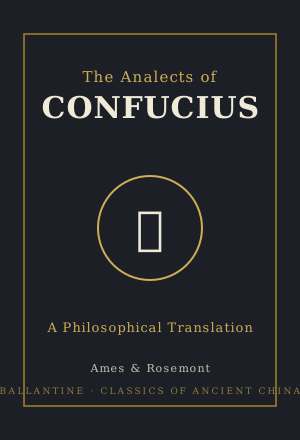 AdvancedPhilosophical
The Analects of Confucius: A Philosophical Translation
A deliberately philosophical rendering, with the Chinese text included and a long interpretive introduction. Ames and Rosemont argue that translating ren as "benevolence" or li as "ritual" quietly smuggles in Western assumptions, and re-translate accordingly. Read against Lau, it shows you vividly how much a translation decides — which is the whole point of ending here.
Paperback / Kindle edition available
View on Amazon Read on Kindle Read our review
The 5 Books at a GlanceCOMPARE
The biggest worry with the Analects is "which translation, and can I actually read it?" Choose by difficulty and by what each edition is for — from a clean standard translation to a scholarly edition with the commentaries attached.
| Title | Difficulty | Length | Type | Best for | Links |
|---|---|---|---|---|---|
| The Analectstr. D. C. Lau · Penguin Classics | Beginner ★☆☆ | ~250 pp. ~5 hrs |
Standard translation | First contact; you want the whole text in clear English | View on Amazon Review |
| The Analects (Annping Chin)tr. Annping Chin · Penguin Classics | Beginner ★☆☆ | ~400 pp. ~7 hrs |
Translation + commentary | You want the text with context under every passage | View on Amazon Review |
| Confucianism: A Very Short IntroductionDaniel K. Gardner · OUP | Intermediate ★★☆ | ~152 pp. ~4 hrs |
Context / introduction | You want the ideas and history around the text | View on Amazon Review |
| Analects: With Traditional Commentariestr. Edward Slingerland · Hackett | Advanced ★★★ | ~320 pp. 1–2 weeks |
Scholarly (with commentary) | You want the passage plus the classical debate over it | View on Amazon Review |
| A Philosophical TranslationAmes & Rosemont · Ballantine | Advanced ★★★ | ~340 pp. 1–2 weeks |
Philosophical translation | You want to see how much the translation itself decides | View on Amazon Review |
A Reading Order That Won't Defeat YouROADMAP
The Analects has no plot and no argument that builds — it is a book of short, scattered sayings. Read cold, in the wrong translation, it can feel like a list of fortune-cookie lines. The cure is order: a clear translation first, the surrounding ideas next, and the scholarly and philosophical versions once you know the text well enough to compare them. Climb in four steps.
-
STEP 1 ── Read it once, in plain English (one book)
Start with Lau's Analects
One clean, complete translation, read straight through. Don't try to memorise or analyse — just let the recurring themes (learning, humaneness, ritual, the exemplary person) surface on their own. Lau's introduction tells you enough to keep your bearings. If you would rather have a note under every line as you go, Chin's translation is the alternative first book.
Lau's Analects on AmazonChin's Analects on Amazon -
STEP 2 ── Get the ideas around the text (book 3)
Read Gardner's Confucianism: A Very Short Introduction
Now step back. Gardner sets out what the key terms mean and how a book of sayings became a civilisation's ethical and political core. With this map, the sayings you just read stop being loose maxims and start forming a coherent picture of how to become a fully realised human being.
Very Short Introduction on Amazon -
STEP 3 ── Reread with the commentators (book 4)
Work through Slingerland's annotated edition
Return to the text, now with the traditional commentaries printed underneath. Here you learn that the Analects has always been argued over — that a single line can carry three defensible readings. Slingerland's apparatus turns reading into interpretation, which is what studying this book has meant for two thousand years.
Slingerland's edition on Amazon -
The goal ── See how much the translation decides
Finish with Ames & Rosemont's philosophical translation
End by reading a version that argues with all the others. Ames and Rosemont deliberately refuse the familiar English words for Confucius's key terms, and their introduction explains why. Set beside Lau, it makes the central lesson of this whole shelf concrete: with a compiled, translated classic, choosing the edition is already an act of interpretation. Once you feel that, you can read any Analects critically. To branch out into wider thought, the general bookshelf network continues the journey.
A Philosophical Translation on AmazonRead our review
How We ChoseCRITERIA
Three criteria. First, currently in print and actually available on amazon.com — every title has a live product page from an established publisher (Penguin Classics, Oxford University Press, Hackett, Ballantine). Second, the ladder must hold: a clear standard translation, then context, then a scholarly and a philosophical edition — each step preparing the next, with an entry point at every height. Third, honesty about what each book is and about the one hard fact: Confucius wrote nothing, the Analects was compiled by disciples, and it exists only in translation — so no single English version is "the" text, and the differences between them are part of the subject, not a nuisance to hide. The reviews say so. Dozens of other respected translations exist (Waley, Watson, Dawson, Leys, Brooks, and more); this shelf picks five that together teach you to read any of them. Difficulty and stars are the editorial room's own judgements, not reproductions of Amazon reviews.
Still Undecided? Take This OneCONCLUSION
If you have read this far and still can't choose, the answer is simple: buy D. C. Lau's Analects. It is the version most readers, students and teachers reach for first — a clear, complete translation with an introduction that hands you the map. Get the whole text into your head once, and every other edition on this shelf — the annotated Chin, the scholarly Slingerland, the philosophical Ames — becomes something you can read against it. "Is it not a pleasure to learn?" This is where that pleasure starts.
Check price & availability on the Amazon product pages