Home › Top 5 › A Philosophical Translation
Review: The Analects of Confucius: A Philosophical Translation — how much the translation decides
★★★★☆4.3 / 5.0 (editorial rating)
Verdict: the version that argues with all the others — and the reason to end here. Ames and Rosemont refuse the standard English words for Confucius's key terms, on the argument that those words quietly Westernise him, and re-translate from the ground up. Read against Lau, it makes the whole shelf's lesson unmistakable: choosing the edition is already an act of interpretation.
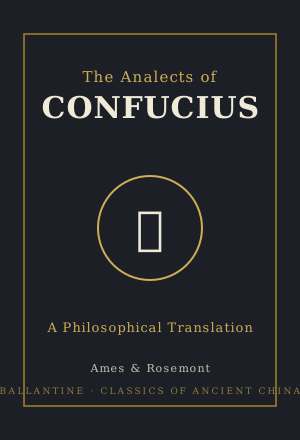
- Title
- The Analects of Confucius: A Philosophical Translation
- Author
- Roger T. Ames & Henry Rosemont Jr.
- Publisher
- Ballantine Books (Classics of Ancient China, 1998)
- Length
- Translation + long introduction + Chinese text · ~340 pp.
- Difficulty
- Advanced ★★★ — argumentative, best read last
Check price & availability on the Amazon product page
What it is — in three lines
Roger T. Ames and Henry Rosemont Jr., two philosophers of Chinese thought, produced this translation with a thesis. They argue that the standard English words for Confucius's central terms — rendering ren as "benevolence," li as "ritual," dao as "the Way" — quietly import Western metaphysical assumptions that are alien to early Chinese thinking, and so distort the philosophy. Their translation therefore re-renders those terms deliberately (for example ren as "authoritative conduct"), backed by a long interpretive introduction and printed alongside the Chinese text. It was also among the first translations to draw on the Dingzhou bamboo-strip manuscript excavated in 1973.
Why it belongs at the end
Read first, this book would mislead — its unfamiliar renderings only make sense as an argument against the familiar ones, so you need the familiar ones in your head first. Read last, it is the perfect capstone. Having gone through Lau's standard English, met the tradition in Gardner, and watched the commentators disagree in Slingerland, you are finally equipped to feel the force of Ames and Rosemont's move. The same passage you know well suddenly reads differently — and you understand, not as an abstract caution but as a concrete experience, that every translation of the Analects is a set of decisions, and that reading well means reading through them.
The Master said, "It is these things that trouble me: failing to cultivate character, failing to go deeper in learning, being unable to move toward what I know to be right, and being unable to reform what is not good."
— Analects 7.3 (editorial gloss of the Chinese)
Ames and Rosemont would have you notice how much even a passage like this shifts depending on how "character," "learning" and "the good" are construed — which is exactly the awareness this shelf is designed to build.
Three highlights
1. Translation as explicit philosophy
Nowhere else will you see the interpretive stakes of translating Confucius laid out so openly. The introduction alone is an education in why the choice of an English word is never neutral.
2. The Chinese on the page
Including the Chinese text signals the book's seriousness and lets readers with any classical Chinese check the rendering — and reminds everyone else that an original stands behind the English.
3. A genuine alternative Confucius
Right or wrong, Ames and Rosemont give you a Confucius who feels distinctly different from the one in the standard versions — relational, processual, this-worldly. Meeting that alternative is what turns a reader into an interpreter.
What to watch out for
Two honest notes. First, this is a strongly interpretive translation, not a neutral one — its renderings follow a specific philosophical reading that not all scholars accept, and it should be read as an argument, not as the plain text. That is a feature here, because you are reading it last and on purpose. Second, the unfamiliar English ("authoritative conduct" for ren, and the like) is hard going as a first encounter and can feel wilfully strange without the standard versions for contrast. Do not start here; arrive here.
Check price & availability on the Amazon product page