Home › Top 5 › Confucianism (VSI)
Review: Confucianism: A Very Short Introduction — the map around the text
★★★★☆4.3 / 5.0 (editorial rating)
Verdict: not a translation, but the context that makes the translations make sense. A hundred and fifty pages that turn a book of scattered sayings into a coherent tradition — what the key terms mean, and how Confucianism became the operating system of imperial China. Read it beside or just after your first Analects.
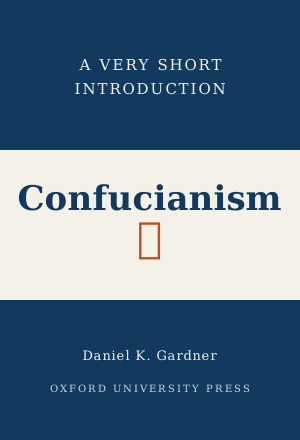
- Title
- Confucianism: A Very Short Introduction
- Author
- Daniel K. Gardner
- Publisher
- Oxford University Press (2014)
- Length
- Introduction · ~152 pp.
- Difficulty
- Intermediate ★★☆ — short but idea-dense
Check price & availability on the Amazon product page
What it is — in three lines
Daniel K. Gardner, a historian of China (Dwight W. Morrow Professor of History at Smith College), wrote this volume in Oxford's Very Short Introduction series. In about 150 pages it lays out the core ideas of the Confucian tradition — ren (humaneness), li (ritual propriety), filial devotion, the junzi — and then follows their extraordinary afterlife: how the sayings of one teacher became state ideology, the syllabus of the civil-service examinations, and the fabric of family and social life across twenty-six centuries. It is a book about the tradition, with the Analects at its centre.
Why context comes before more translations
Once you have read the Analects once, the obstacle is no longer the language — it is knowing what the recurring terms actually carry. "Ritual" sounds empty to a modern ear until you understand that li covers everything from state ceremony to the way you greet your father; "humaneness" is vague until you see how ren functions as the highest human achievement. Gardner supplies exactly this. He also explains why the book mattered so enormously — a point no translation's introduction has room to develop — so that the Analects stops looking like a collection of nice sayings and starts looking like the seed of a civilisation's entire moral vocabulary.
To learn without thinking is labour lost; to think without learning is perilous.
— Analects 2.15 (editorial gloss of the Chinese)
Gardner's book is, in a sense, an extended demonstration of that line: the reading (the Analects) and the thinking (the tradition's development) each need the other.
Three highlights
1. The key terms, made concrete
Gardner's explanations of ren, li and the junzi are the clearest short account we know. After this book, the abstractions in every translation acquire weight.
2. From a book to a state
The story of how Confucianism became imperial orthodoxy and the basis of the examination system is genuinely gripping, and it is the part a first reader of the Analects is most likely to be missing.
3. Short, current, and cheap to try
At around 150 pages by a leading historian, it is the most efficient way to buy yourself the context that would otherwise take a much larger book — and its Kindle sample lets you test the fit first.
What to watch out for
Two honest notes. First, this is a book about Confucianism, not the Analects itself. It is context, not text; do not let it substitute for reading Confucius in his own words (that is why it sits third here, after two translations, not first). Second, the Very Short Introduction format is compressed: 150 pages across twenty-six centuries means real subjects — later Confucianism, the great Neo-Confucian thinkers — get only a few pages each. Treat it as a map that shows you where things are, not the full survey of any one of them.
Check price & availability on the Amazon product page