Home › Top 5 › The Human Condition
Review: The Human Condition — Arendt's masterwork on labor, work, and action
★★★★★4.7 / 5.0 (editorial rating)
Verdict: the heart of Arendt, and the most demanding book on this shelf. She divides human activity into labor, work, and action, and mourns the modern shrinking of the public realm where action and freedom belong. Take it on after the life and Eichmann — with your footing sure, the masterwork stops being a wall and becomes a landscape.
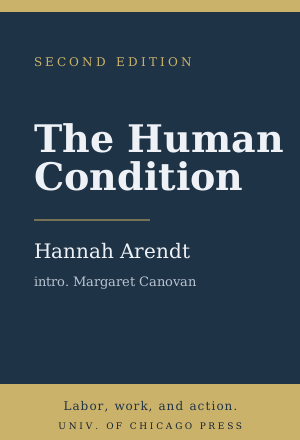
- Title
- The Human Condition (Second Edition)
- Author / Intro
- Hannah Arendt; introduction by Margaret Canovan
- Publisher
- University of Chicago Press
- Length
- ~370 pp.
- Difficulty
- Advanced ★★★ — three to four weeks
Check price & availability on the Amazon product page
What it is — in three lines
Published in 1958, The Human Condition is Arendt's central work of political philosophy: an inquiry into the vita activa, the life of doing, and what it means for humans to act and appear among others. This University of Chicago second edition carries Margaret Canovan's authoritative introduction, which maps the argument before you enter it. It is not a book about totalitarianism; it is the positive theory of politics and freedom that underlies everything else Arendt wrote.
The core — labor, work, action
Arendt separates three human activities we usually blur together. Labor is the endless work of keeping the body alive — cyclical, consuming, leaving nothing behind. Work fabricates a durable world of things — tools, buildings, artworks — that outlasts us. Action is what happens between people who speak and act in public: unpredictable, world-founding, the only activity in which we are truly free and truly ourselves. Her worry is that modernity has elevated labor and consumption while letting the public space of action wither.
Action, the only activity that goes on directly between men without the intermediary of things or matter, corresponds to the human condition of plurality.
— Hannah Arendt, The Human Condition
Read after Eichmann, the stakes are clear: a world with no room for thinking and acting together is exactly the soil in which thoughtlessness grows.
Three highlights
1. A vocabulary that changes how you see
Once the labor / work / action distinction lands, you cannot un-see it — in your own days, in politics, in the news. Few philosophical frameworks are as portable.
2. Plurality and the public realm
Arendt's insistence that we are plural — that politics happens among distinct people, not inside one mind — is her deepest and most original move, and the book makes you feel why it matters.
3. Canovan's introduction
The second edition's introduction is one of the best short guides to Arendt in print; it gives you the shape of the whole argument so you never lose the thread in the detail.
What to watch out for
Two honest notes. First, this is a genuine philosophy classic and it is hard: Arendt argues through Greek and Roman sources and coins her terms as she goes, so it rewards slow reading and rereading. Do not make it your first Arendt — come to it after Hill's life and Eichmann, and read Canovan's introduction first. Second, it is a work of concepts, not of current events; the payoff is a way of thinking, not a set of policies. Give it the weeks it asks for and it repays them.
Check price & availability on the Amazon product page