Home › Top 5 › Hannah Arendt (Critical Lives)
Review: Hannah Arendt (Critical Lives) — the best first book on Arendt
★★★★★4.6 / 5.0 (editorial rating)
Verdict: the ideal way in. Before you open a word of Arendt's own difficult prose, spend a few evenings with Samantha Rose Hill's short life and you will meet the thinker through the century she lived — exile, statelessness, friendship, and the controversies that shaped the books. It makes everything after it read faster and deeper.
- Title
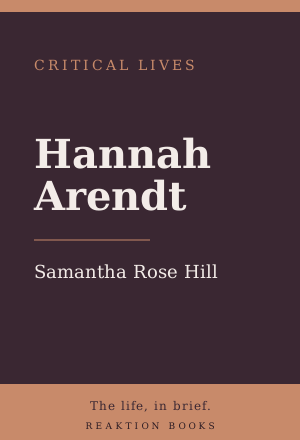
- Hannah Arendt (Critical Lives)
- Author
- Samantha Rose Hill
- Publisher
- Reaktion Books (Critical Lives series)
- Length
- ~232 pp.
- Difficulty
- Beginner ★☆☆ — about five hours
Check price & availability on the Amazon product page
What it is — in three lines
Samantha Rose Hill's Hannah Arendt is a slim entry in Reaktion's Critical Lives series: a compact biography that tells Arendt's story and threads her major works into it. Hill, who has also translated Arendt's poems and edited her writing, draws on letters, archival documents, and verse to give you the woman as well as the thinker. It is short, humane, and — crucially for a first book — never assumes you have read a line of Arendt yet.
The core — a life that explains the work
The reason to start here is simple: Arendt's ideas are inseparable from her century. Hill follows the arc — a German-Jewish childhood, study under Heidegger and Jaspers, flight from the Nazis, internment in France, statelessness, and a new life in New York — and shows how each great book answered something she had lived through. The Origins of Totalitarianism, The Human Condition, and Eichmann in Jerusalem stop being intimidating titles and become responses to real events.
The moment we begin to think, we bring ourselves into being.
— Hannah Arendt, quoted in Hill, Hannah Arendt
What keeps it from being a dry chronology is Hill's feel for Arendt's inner life — the friendships, the loyalties, the wounds of the Eichmann controversy — so that the thinker who prized "thinking" and "the world" appears as a person, not a syllabus.
Three highlights
1. Short, and genuinely a beginning
At around 230 pages this is a few evenings' reading, and it is pitched at the newcomer. You finish with a map of the whole career — which books matter, in what order, and why — before you have committed to a single dense chapter.
2. The letters and the poems
Hill's access to Arendt's correspondence and verse gives the book a texture most short lives lack. You hear Arendt's own voice, off duty, alongside the public arguments.
3. The controversies, handled fairly
The relationship with Heidegger and the firestorm over Eichmann in Jerusalem are told with care rather than sensationalism — exactly the grounding you want before you read that book for yourself.
What to watch out for
Two honest notes. First, this is a biography, not Arendt's own philosophy: it is the scaffolding, not the building, and Hill is careful to summarise rather than to substitute for the primary texts. Treat it as the door, then walk through it. Second, a short life must be selective — the readings of individual books are brisk, and a reader who wants the full scholarly life will later want Elisabeth Young-Bruehl's much longer Hannah Arendt: For Love of the World. For a first book, though, Hill's brevity is precisely the point.
Check price & availability on the Amazon product page