Review: On Revolution — freedom, founding, and why two revolutions diverged
★★★★★4.5 / 5.0 (editorial rating)
Verdict: the reach of Arendt's political thought, and the toughest climb on this shelf. She sets the American and French revolutions side by side and asks why one founded a lasting space of freedom while the other collapsed into terror. It is The Human Condition's theory of action tested against real history — rich in prerequisites, and worth every one of them.
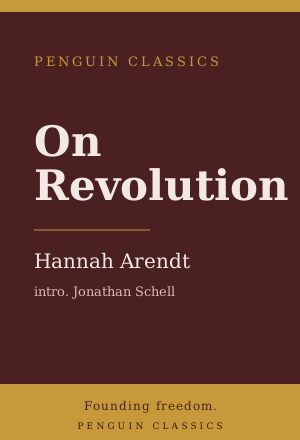
- Title
- On Revolution
- Author / Intro
- Hannah Arendt; introduction by Jonathan Schell
- Publisher
- Penguin Classics
- Length
- ~368 pp.
- Difficulty
- Advanced ★★★ — three to four weeks
Check price & availability on the Amazon product page
What it is — in three lines
Published in 1963, On Revolution is Arendt's comparative study of the modern revolutionary tradition, centred on America and France. This Penguin Classics edition carries an introduction by Jonathan Schell. It is the companion to The Human Condition: where that book theorised "action" and public freedom, this one asks what happens when whole peoples try to found freedom in the real world — and why the attempt succeeds or fails.
The core — freedom vs. the social question
Arendt's provocative claim is that the American Revolution largely succeeded and the French largely failed — and not for the reasons usually given. The Americans, she argues, kept their eyes on the properly political task: founding durable institutions of public freedom. The French let the revolution be swallowed by "the social question" — mass poverty and necessity — which turned politics into an emergency of compassion and cleared the road to terror. Freedom, for Arendt, is founded by building a space to act in, not by relieving want alone.
The end of rebellion is liberation, while the end of revolution is the foundation of freedom.
— Hannah Arendt, On Revolution
Whether or not you accept the verdict — and many historians contest it — the diagnosis is a bracing lens on every modern politics that confuses freedom with the satisfaction of needs.
Three highlights
1. The theory made concrete
This is where "action" and "the public realm" stop being abstractions and get tested against events, constitutions, and founders. Read after The Human Condition, it snaps the concepts into focus.
2. Founding and "public happiness"
Arendt's recovery of the revolutionary experience of "public happiness" — the joy of acting in common — is one of the most inspiring threads in her work.
3. A genuinely political reading of America
Her admiring, unusual account of the American founding — and its lost "treasure" of council-democracy — makes the book quietly radical, and endlessly debated.
What to watch out for
Two honest notes. First, this is the most prerequisite-heavy book on the shelf: it leans on the vocabulary of The Human Condition and assumes some knowledge of the two revolutions, so it is the wrong place to begin. Second, its historical judgements are contested — Arendt's picture of the French Revolution and of poverty has drawn serious criticism. Read it as a provocation to think about freedom and founding, not as settled history, and it richly rewards the effort. This is the summit; enjoy the view.
Check price & availability on the Amazon product page