Home › Top 5 › Responsibility and Judgment
Review: Responsibility and Judgment — thinking, judging, and the roots of "the banality of evil"
★★★★★4.5 / 5.0 (editorial rating)
Verdict: where "the banality of evil" becomes a full argument. After the storm over Eichmann, Arendt spent her last years asking how, under organised wrong, ordinary people surrendered the power to tell right from wrong. These late essays — edited by Jerome Kohn — are the principled deepening of her most controversial idea: an inquiry into thinking, judging, and moral responsibility.
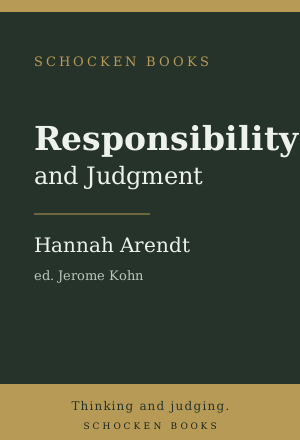
- Title
- Responsibility and Judgment
- Author / Editor
- Hannah Arendt; edited and with an introduction by Jerome Kohn
- Publisher
- Schocken Books
- Length
- ~304 pp.
- Difficulty
- Advanced ★★★ — two to three weeks
Check price & availability on the Amazon product page
What it is — in three lines
Responsibility and Judgment gathers essays and lectures from the last decade of Arendt's life, published after her death and edited with an introduction by Jerome Kohn, who worked closely with her. At its centre is the long essay "Some Questions of Moral Philosophy." The book takes up the problem Eichmann in Jerusalem had opened — how good people fail, and how anyone resists — and works it out slowly, on principle rather than on a single trial.
The core — thinking, judging, responsibility
Arendt's question is disarmingly plain: under a criminal regime, where the "done thing" is monstrous, what allows a person to know it and refuse? Her answer turns on two faculties. Thinking — the silent dialogue with oneself — keeps a person from becoming the kind who simply goes along. Judging — the ability to tell right from wrong without a rule handed down — is what totalitarian conditions try hardest to destroy. Moral responsibility, for Arendt, is finally the refusal to stop doing either.
The greatest evil is not radical, it has no roots, and because it has no roots it has no limitations, it can go to unthinkable extremes and sweep over the whole world.
— Hannah Arendt, Responsibility and Judgment
This is the argument the phrase "the banality of evil" was pointing at all along — here given the patient philosophical treatment the report could only gesture toward.
Three highlights
1. "Some Questions of Moral Philosophy"
The centrepiece essay is among the most rewarding things Arendt wrote on ethics: rigorous, unshowy, and directly concerned with how ordinary conscience can hold or fail.
2. The Eichmann debate, resolved on principle
Read after the report, this book answers the caricatures. It shows that "banality" was never an excuse but a diagnosis — of thoughtlessness — and it says so in careful, defensible terms.
3. Kohn's editorial framing
Jerome Kohn's introduction and arrangement turn scattered late pieces into a coherent argument, which is a real service given that Arendt never assembled the book herself.
What to watch out for
Two honest notes. First, it is a posthumous collection, not a single seamless treatise: the essays overlap and were written for different occasions, so the reading is less linear than a book Arendt shaped herself. Second, it truly depends on Eichmann in Jerusalem — read that first, or much of the point will be invisible. Come to it as the sequel it effectively is, and it is the place where her ethics finally stands still long enough to be seen whole.
Check price & availability on the Amazon product page