Review: Meditations — the words an emperor wrote for himself alone
★★★★☆4.3 / 5.0 (editorial rating)
Verdict: the first original to open. A man at the summit of the Roman Empire wrote these notes with no publication and no audience in mind, only to steady and correct himself — so there is no performance in them, no front. No other book shows so nakedly how Stoic practice was actually used, moment to moment, by someone under real pressure. Read it in Gregory Hays's clear, modern translation.
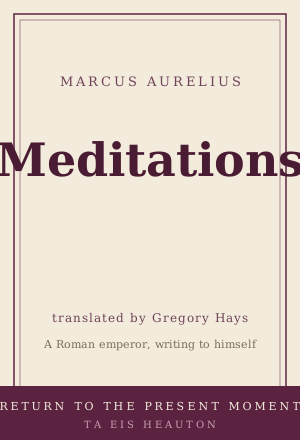
- Title
- Meditations
- Author
- Marcus Aurelius, tr. Gregory Hays
- Publisher
- Modern Library
- Type
- Original (a notebook in twelve books, in short entries)
- Difficulty
- Intermediate ★★☆ — the entries are plain, but far richer once you know the framework
Check price & availability on the Amazon product page
What it is — in three lines
Marcus Aurelius was a Roman emperor of the second century, later counted the last of the "Five Good Emperors." Meditations is the collection of reflections he wrote to himself in Greek, amid the grind of campaigns and government — never intended for anyone else's eyes. It runs to twelve short "books" of brief entries; the right posture is to read it not as a systematic treatise but as what it is, a set of notes for setting oneself straight.
The core — turning back to "now" and "my own mind"
Two axes run through the mass of entries. First, live only in this present moment — the past is gone and the future not yet here; the only thing anyone can lose is the passing now, so give it your attention. Second, correct your own judgment, not the world outside you — other people's actions and external events lie beyond your control, and whether they disturb you depends on how you take them. This is the dichotomy of control, in practice.
The mind is not disturbed by things themselves, but by its own judgments about them — take away the judgment, and the disturbance is gone. (An editorial gloss of a theme running through Books 4 and 8, not a quotation of the Hays translation.)
— Marcus Aurelius, Meditations, central idea (editorial gloss of the original)
What gives the book its force is the paradox at its center: a man in a position to command almost anything keeps reminding himself to let go of what he cannot command. At the height of power, he knew that the only thing he truly controlled was his own mind.
Three highlights
1. The opening of Book 2 — bracing for difficult people
Tell yourself at dawn that you will meet the meddling, the ungrateful, the arrogant — and resolve not to be surprised or dragged down, because they share the same nature as you. The famous opening of Book 2 is a practical prescription for other-people stress, and a textbook case of negative visualization.
2. The entries on death — memento mori
Reflections on mortality recur throughout. Emperor and slave die alike; fame is forgotten soon enough — set down not as a threat but as a quiet premise, and the outline of what actually matters now sharpens. The Stoic meditation on death, written in an emperor's everyday voice.
3. Gregory Hays's translation
The Modern Library version is widely loved for exactly the quality the text needs: Hays renders the notes in spare, direct modern English that keeps their bluntness and momentum, and his introduction is a fine short account of who Marcus was and why the book reads as it does.
Where readers stall, and how to read it
The cause of failure is nearly always one thing: trying to read it straight through as a "book." It does not build an argument; the same themes return in different words, over and over. Read cover to cover, extracting every meaning, and it feels monotonous. Better to mark the entries that land and return to them on other days — keep it by the bed, a passage a night is fine. And — this matters — do not start here. The reason this site puts modern intros (like Irvine) first is that, once the dichotomy of control is in place, these scattered notes suddenly stand up with a single spine.
Check price & availability on the Amazon product page