Home › Top 5 › A Guide to the Good Life
Review: A Guide to the Good Life — a 2,000-year-old philosophy, put to work on today's worries
★★★★☆4.4 / 5.0 (editorial rating)
Verdict: the right first Stoicism book. A working philosopher takes the ancient school apart and rebuilds it as something you can actually run — a set of psychological techniques aimed at tranquility and, yes, joy. This is a book about how to use Stoicism, not a history of it, and it lays a bridge straight to the originals. For first contact, nothing on this shelf is safer.
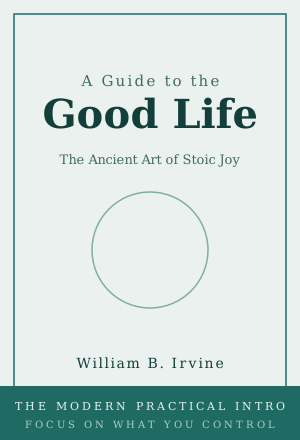
- Title
- A Guide to the Good Life: The Ancient Art of Stoic Joy
- Author
- William B. Irvine (professor of philosophy, Wright State University)
- Publisher
- Oxford University Press
- Type
- Modern practical intro (thematic)
- Difficulty
- Beginner ★☆☆ — no prior knowledge needed, about 6 hours
Check price & availability on the Amazon product page
What it is — in three lines
William B. Irvine is an academic philosopher who, in midlife, went looking for a philosophy to actually live by and chose Stoicism. The book is the record of that choice, written for readers in the same position. It spends almost no time on doctrine for its own sake and stays fixed on a single question: so what do I do today? The rare intro that combines a scholar's care with a practitioner's urgency.
The core — the technique of the dichotomy of control
The starting point of Stoic practice is one distinction, drawn from Epictetus: some things are up to us and some are not, and only the first — our own judgments, choices and actions — lie within our power. Other people's opinions, the past, outcomes, the weather: all outside it. So stop clinging to what you cannot control, and pour everything into what you can. This is the "dichotomy of control."
Irvine's value is that he refuses to let this end at "knowing." He shows how to apply it in the actual moment — when anger flares, when you are criticized, when anxiety is about to take over. Against the common caricature of Stoicism as gritted-teeth emotional suppression, he presents it as the skill of pausing, before you react, to ask whether this is even yours to control. By the last page the dichotomy is not a fact you have learned but a habit you can use.
Three highlights
1. Negative visualization, made concrete
Irvine's signature is his treatment of negative visualization — deliberately picturing the loss of what you have, so that the ordinary stops feeling ordinary. He frames it not as gloom but as the most reliable antidote to taking your life for granted, and gives it as an exercise you can run tonight rather than a doctrine to admire.
2. Stoicism as a path to joy, not endurance
The subtitle — The Ancient Art of Stoic Joy — is the argument. Irvine insists the Stoic goal is tranquility, a life with less negative emotion and more gratitude, and he makes the case well enough that the word "stoic" stops meaning "cold." That reframing is what gets a defeated reader back on their feet.
3. A built-in bridge to the originals
Because Irvine keeps returning to Marcus, Seneca and especially Epictetus, you finish the book already introduced to the primary voices — which is exactly why it makes a better on-ramp to Meditations and the Discourses than a bare summary would.
What to watch out for
Two honest notes. First, this is a modern practical intro, not a history or system of Stoic philosophy: the school's development from Zeno on, and its full theoretical apparatus (logic and physics included), get light treatment. That work belongs to the originals and to scholarly studies; this book stays a doorway into Stoicism as a way of life. Second, Irvine reworks Epictetus's dichotomy into his own "trichotomy of control" and reads the tradition through a distinctly modern, psychological lens — a reading some scholars find idiosyncratic. He is candid about departing from the ancient text, and so are we: take it as an excellent interpretation to start from, not as ancient Stoicism verbatim.
Check price & availability on the Amazon product page