Home › Top 5 › Discourses and Selected Writings
Review: Discourses and Selected Writings — where Stoic practice began
★★★★☆4.0 / 5.0 (editorial rating)
Verdict: recommended as the goal — but save it for last. Stoicism's signature idea, the dichotomy of control, was forged by this one man: Epictetus, born a slave and later a teacher. Marcus, Seneca, Irvine and Holiday all trace back here. It is substantial and demanding, and opening it cold is rough. But for a reader who has climbed the earlier steps, this is what "drinking from the source" feels like. Robert Dobbin's Penguin selection pairs the lectures with the Handbook.
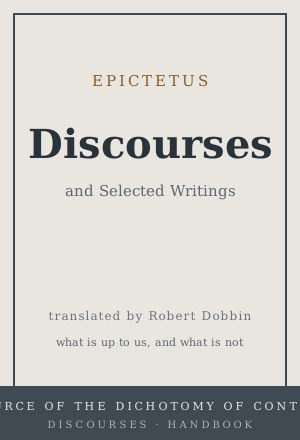
- Title
- Discourses and Selected Writings
- Author
- Epictetus, tr. Robert Dobbin
- Publisher
- Penguin Classics
- Type
- Original (selected lecture notes plus the Enchiridion / Handbook)
- Difficulty
- Advanced ★★★ — length and repetition are the barrier, though the content is plain
Check price & availability on the Amazon product page
What it is — in three lines
Epictetus rose from slavery to become, after his freedom, a teacher of philosophy in the first and second centuries. He wrote nothing himself; the Discourses are the record his student Arrian made of his lectures and exchanges — in effect, a live transcript of the classroom. So the prose is not a chain of propositions but a voice: goading students, driving a point home with example after example. Dobbin's Penguin volume selects from the surviving Discourses and includes the Enchiridion (Handbook), Epictetus's own condensed summary.
The core — begin with "what is up to us"
Everything in Epictetus starts from a single division. Some things are up to us and some are not. Up to us: our judgments, our impulses, our desires, our own actions. Not up to us: our body, property, reputation, position — whatever others or fortune finally hold. Unhappiness comes from mistaking the second kind for the first, and clutching at it. So release what is not in your power as "not mine" from the start, and put your whole care into the one thing that is — your own mind. This is the origin of what later got the name "the dichotomy of control."
Some things are within our power, and some are not. Within our power are judgment, impulse, desire; not within it are the body, property, reputation. To stay unshaken, do not treat what is not yours as though it were. (An editorial gloss of the opening of the Enchiridion, ch. 1, not a quotation of the Dobbin translation.)
— Epictetus, Enchiridion 1 (editorial gloss of the original)
It can sound abstract. But to a reader who has come through the earlier four — Irvine's exposition, the emperor's notebook, Seneca on time — it reads as "the very first way of saying the thing you already know." The water at the source is clear, and cold.
Three highlights
1. The immediacy of a live classroom
Because it is a record of teaching, not a treatise, you catch Epictetus seeing through a student's excuses and pushing back. The heat of a teacher trying to drive philosophy in as daily training — not as knowledge — is the book's greatest asset.
2. An overwhelming wealth of examples
Travel, illness, bereavement, dinner parties, losing a job — Epictetus hates abstraction and keeps forcing the same question onto ordinary life: is this up to me? So a lecture from two thousand years ago applies, unchanged, to your own day.
3. The fountainhead of later Stoicism
Marcus Aurelius's Meditations owes an openly acknowledged debt to Epictetus, and reading this makes the background of the emperor's entries snap into focus. Come here after Marcus and much of it reads like an answer key.
Where readers stall, and how to read it
Two causes of failure. First, length: even a selection is substantial, and the same themes return from many angles. Do not aim to read it straight through; go chapter by chapter. Second, because it is a transcript, it wanders and digresses — expect a straight-line argument and you get lost. The remedy is this site's reading order: put the framework in place with a modern intro and the emperor's notebook first, and the digressions all resolve to the same point (attend to what is up to you). If you want the essence first, the Enchiridion — Epictetus's own digest, included in this volume — is a fine place to start.
Check price & availability on the Amazon product page