Home › Top 5 › Letters from a Stoic
Review: Letters from a Stoic — philosophy delivered as letters to a friend
★★★★☆4.2 / 5.0 (editorial rating)
Verdict: a primary text that reads almost like an easy chair. Seneca wrote these letters to a younger friend, Lucilius, on time, money, fear, illness and how to live — and the form does the work: no treatise, just warm, quotable prose you keep underlining. The most approachable of the Stoic originals, in Robin Campbell's Penguin selection.
- Title
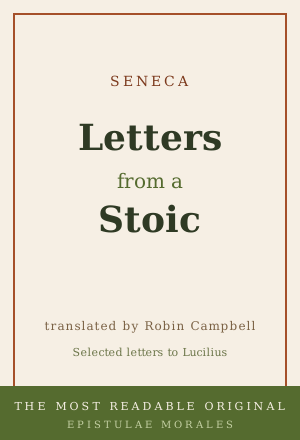
- Letters from a Stoic (Epistulae Morales ad Lucilium, selected)
- Author
- Seneca, tr. Robin Campbell
- Publisher
- Penguin Classics
- Type
- Original (a selection of the moral letters)
- Difficulty
- Intermediate ★★☆ — plain and inviting, about 5 hours
Check price & availability on the Amazon product page
What it is — in three lines
Seneca was a first-century Roman statesman, dramatist and Stoic philosopher — tutor and adviser to the emperor Nero. The Letters are the moral letters he addressed, late in life, to his friend Lucilius: short essays in the guise of correspondence, each turning over a single question of how to live. A primary text without a trace of dryness, written in a supple, image-rich style that reads as fine essay-writing to this day. Campbell's Penguin volume is a generous selection rather than the complete run.
The core — fear, time, and the freedom of the mind
Seneca's recurring targets are the things that steal a life from the inside: the fear of misfortunes that mostly never arrive, and the casual squandering of time. We guard our money and property, he argues, yet hand our irreplaceable hours to anyone who asks — and we mistake being busy for being alive.
We suffer more often in imagination than in reality; it is our own opinion of a thing that torments us, more than the thing itself. (An editorial gloss of the argument of Letter 13, not a quotation of the Campbell translation.)
— Seneca, Letters 13 (editorial gloss of the original)
This is the dichotomy of control turned inward on emotion: the event may be outside you, but the dread is your own judgment, and the judgment is up to you. For a modern reader wired to anticipate disaster, the counsel is uncomfortably exact.
Three highlights
1. "It is not that we have a short time to live, but that we waste much of it"
Seneca's argument about time — that life is long enough for anyone who knows how to use it — runs through the letters and lands with unusual force on a calendar-driven, notification-driven age. Living on other people's schedules, he insists, is not the same as living.
2. Consolation without cant
On grief, illness, exile and death, Seneca is bracing rather than sentimental. He does not deny that these things hurt; he asks what part of the suffering you are adding yourself — and that is a question you can act on.
3. The letter form itself
Because each piece is aimed at one friend and one problem, the philosophy arrives at human scale: a paragraph of argument, an example, a line you copy out. It is the least intimidating way into a Stoic original, which is exactly why it sits here in the reading order.
What to watch out for, and how to read it
Two honest notes. First, Seneca is a writer often charged with not practicing what he preached: he counseled simplicity and indifference to wealth while holding an enormous fortune and real political power, and the contradiction has been pointed out since antiquity. Read with that in view, some passages sit uneasily — though the tension is part of what makes him worth reading, not a reason to skip him. Second, this is a primary text, not a modern self-help manual: there are no numbered steps. The value jumps when you read actively — copy out the line that struck you, hold it against your own use of time and fear. Several English selections and translations exist; Campbell's Penguin is the standard readable choice, and comparing renderings is part of the pleasure.
Check price & availability on the Amazon product page