The Way of Zen review — the readable door into Eastern thought
★★★★☆4.3 / 5.0 (our rating)
Verdict: The book that keeps your reading list from being only Western. Watts traces Zen back to its roots in Taoism and Indian Buddhism, then forward to how it actually sees — and he does it in prose that stays clear where the subject most invites fog. Nearly seventy years on, it is still the most readable single door into Eastern thought.
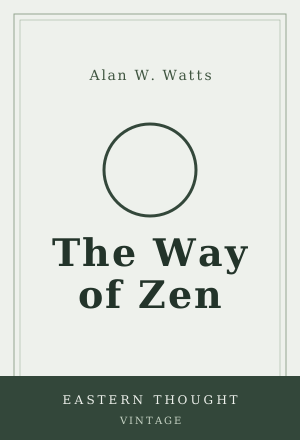
- Title
- The Way of Zen
- Author
- Alan W. Watts
- Publisher
- Vintage
- Format
- ~250 pp
- Difficulty
- Intermediate ★★☆ — about 7 hours
Kindle edition available/prices and availability on Amazon
What it is — in three lines
Alan Watts (1915–1973) was the British writer who did more than anyone to explain Eastern philosophy to Western readers. Published in 1957, The Way of Zen is his most careful book: the first half is history and background (Taoism, Buddhism, the rise of Zen in China and Japan), the second half is Zen's principles and practice. It remains a standard first book on the subject.
Background then practice
Watts's structure is the reason to trust him. Rather than open with paradoxes and koans — the fog most Zen books get lost in — he builds the ground first: the Taoist idea of the Tao, the Buddhist analysis of suffering and the self, and only then how Zen distils these into a way of seeing that resists being put into words. By the time he reaches "za-zen" and the koan, you have the context to understand why Zen distrusts the very explanations he has been giving. For a Western reader raised on argument, that scaffolding is what makes the leap intelligible instead of merely mystifying.
Three things to look for
1. The chapter on the Tao
The early treatment of Taoism — the watercourse way, wu-wei (non-forcing) — is worth the book on its own, and reframes a lot of Western assumptions about effort and control.
2. Watts as a stylist
He writes about the ineffable without either flattening it or drowning it. That balance is the book's real achievement and the reason it has outlasted flashier introductions.
3. A different shape of question
After four Western-leaning books, Zen's suspicion of concepts and words is a genuine jolt — a reminder that "philosophy" is a wider thing than the Greek-to-German line.
One caveat
Two, honestly. First, this is a 1950s book by a populariser, not a monk or a modern scholar; Watts interprets, and specialists debate some of his emphases. Read it as a superb door, then, if it grips you, go to primary Buddhist texts or a modern academic survey. Second, it sits a step above the pure-entry titles — take it after you've warmed up with Sophie's World or A Little History.
Prices and availability are on the Amazon product page.