Think review — read this last, and start doing philosophy
★★★★★4.4 / 5.0 (our rating)
Verdict: The finish line of this list — and read it last, deliberately. Where the earlier books tell you the stories and draw the map, Blackburn puts you to work on the problems themselves: knowledge, mind, free will, the self, God, reasoning. It's the moment you stop reading about philosophy and start doing it. Get through Think and you're ready for the primary texts.
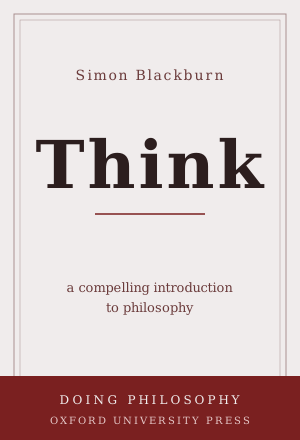
- Title
- Think: A Compelling Introduction to Philosophy
- Author
- Simon Blackburn
- Publisher
- Oxford University Press
- Format
- ~300 pp, 8 chapters
- Difficulty
- Serious ★★★ — about 10 hours
Kindle edition available/prices and availability on Amazon
What it is — in three lines
Simon Blackburn is one of the most distinguished philosophers of his generation — a Cambridge professor — who chose to write a real introduction for real beginners. Think (1999) is organised not by thinker but by problem: eight chapters on knowledge, mind, free will, the self, God, reasoning, the world, and what we can hope. It has become a standard first "serious" philosophy book in the English-speaking world.
Problems, not portraits
This is the crucial difference from everything above it on the list. A survey tells you that Descartes doubted; Think makes you sit inside the doubt and ask whether it works. Blackburn takes a question — do I have free will? can I know the world is real? — and walks you through the strongest moves and counter-moves, so you finish each chapter holding an argument, not a fact. It's demanding in the right way: you are asked to evaluate, not memorise. That is what "doing philosophy" means, and it's why this belongs at the end of the ladder — after the earlier books have given you the reasons to care and the map to place the problems.
Three things to look for
1. The chapters on Knowledge and Free Will
The opening treatment of Descartes and scepticism, and the later chapter on determinism and freedom, are model expositions — clear enough for a beginner, honest enough that a graduate student learns from them.
2. Rigour without jargon
Blackburn defines his terms and refuses to hide behind them. When a concept is genuinely hard, he says so and slows down — the mark of a confident teacher.
3. It changes how you read the news
Once the reasoning chapter has retooled how you spot a bad argument, you don't switch it off. This is the book whose effects follow you out of the room.
One caveat
Don't make it your first book. Its virtue — that it argues rather than narrates — is exactly what overwhelms a cold-start reader, which is why our order puts it fifth. Come to it after Sophie's World and A Little History, and its demands feel like the natural next step rather than a wall. It is also firmly in the Western analytic tradition; pair its outlook with The Way of Zen for contrast.
Prices and availability are on the Amazon product page.