Sophie's World review — the best first philosophy book there is
★★★★★4.6 / 5.0 (our rating)
Verdict: Your first philosophy book should be this one. It hides the entire history of Western thought inside a mystery novel, so you learn Plato, Descartes and Kant while turning pages to find out what's actually going on. Nothing else on this list is so hard to put down — which is exactly the property a first book needs.
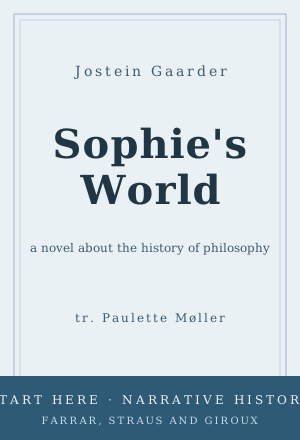
- Title
- Sophie's World
- Author
- Jostein Gaarder (tr. Paulette Møller)
- Publisher
- Farrar, Straus and Giroux
- Format
- Novel, ~500 pp
- Difficulty
- Entry ★☆☆ — about 10 hours
Kindle edition available/prices and availability on Amazon
What it is — in three lines
Fourteen-year-old Sophie Amundsen finds anonymous notes in her mailbox asking "Who are you?" and "Where does the world come from?" A correspondence course in philosophy begins — and then the story turns strange in a way that becomes, itself, a philosophical point. First published in Norway in 1991, it went on to sell tens of millions of copies worldwide.
Why the novel form works
Most histories of philosophy fail beginners for the same reason: they front-load names and dates before you have any reason to care. Gaarder solves this by making curiosity the engine. You keep reading to find out who is sending the letters and what is happening to Sophie — and the Pre-Socratics, Plato, the Enlightenment and Kant arrive as answers you actually wanted. By the time the plot delivers its famous twist, you've absorbed a genuine survey of Western thought without once feeling lectured to. That is a rare piece of craft, and it's why this book, not a textbook, belongs first.
Three things to look for
1. Each philosopher gets a real idea, not just a portrait
The lessons are short but not empty: Plato's forms, Descartes' doubt, Hume's scepticism each arrive with their actual argument in miniature. You come away able to recognise the moves, not just the names.
2. The frame story is philosophy, not decoration
Without spoiling it: the question "how do I know I'm real?" stops being an abstraction and becomes the plot. The form embodies the content — the highest compliment you can pay a teaching novel.
3. It earns the length
At around 500 pages it looks daunting, but the chapters are short and the momentum is real. Treat it as the beach read it secretly is.
One caveat
It's a survey by design, so no single thinker is treated in depth, and the sheer coverage means the later modern chapters move fast. That's the correct trade for a first book — breadth over depth. When a particular philosopher grabs you, don't try to satisfy it here; that's what A Little History of Philosophy and our author-by-author sister shops are for.
Prices and availability are on the Amazon product page.