Home › Top 5 › Why I Am So Wise
Review: Why I Am So Wise — the most immodest introduction in philosophy, and why the immodesty is the point
★★★★☆4.0 / 5.0 (editorial rating)
Verdict: the best cheap ticket to Nietzsche's own voice. Ninety-six pages from Ecce Homo, the self-portrait he wrote in his last sane year, with chapter titles like the book's own — "Why I Am So Wise," "Why I Write Such Good Books." For anyone who wants the man himself, unfiltered, in under two hours — and is willing to learn why the bragging is not what it looks like.
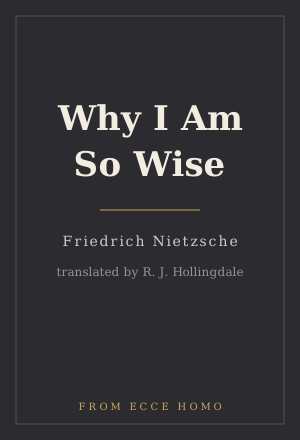
- Title
- Why I Am So Wise (Penguin Great Ideas)
- Author
- Friedrich Nietzsche, tr. R. J. Hollingdale
- Publisher
- Penguin (2005)
- Length
- 96 pp.
- Difficulty
- Beginner ★☆☆ — short, sharp, strange
Check price & availability on the Amazon product page
What it is — in three lines
A pocket selection from Ecce Homo (written 1888, weeks before Nietzsche's collapse): the philosopher reviewing his own life and books, explaining his diet, his climate, his recreations, and why he is a destiny. Hollingdale's classic translation. The strangest and most quotable self-portrait in the history of philosophy.
The bragging is a philosophical act
"Why I Am So Wise" reads as megalomania until you notice what the chapters actually do: a man in constant pain, nearly blind, unread and alone, is performing the amor fati he preached — refusing to resent a single fact of his life.
My formula for greatness in a human being is amor fati: that one wants nothing to be different — not forward, not backward, not in all eternity.
— Nietzsche, Ecce Homo, "Why I Am So Clever" §10 (editorial gloss of the German original)
Read that sentence against the biography — the migraines, the isolation, the books nobody bought — and the comedy of the chapter titles turns into something closer to defiance. That double exposure is the book's real lesson, and no summary can deliver it; only the voice can.
Three highlights
1. The physiology of philosophy
Diet, climate, place — Nietzsche insists these are philosophical questions, and reading him on Turin weather and strong tea is the fastest cure for the idea that philosophy lives only in the head.
2. How to read his other books
The middle chapters review his own works one by one — opinionated, unreliable and completely fascinating. As a guide to what to read next, it is the author's own annotated bibliography.
3. "I am not a man, I am dynamite"
The closing pages, on why he is a destiny, are the most famous self-assessment in philosophy — written by a man the world had not yet noticed, and about to be proven right. History's strangest confirmed prediction.
What to watch out for
Three honest notes. First, this is a selection from Ecce Homo, not the complete text; if the voice takes, the full work (and The Gay Science) is the natural sequel. Second, context matters enormously here: written on the edge of collapse, the book's grandiosity has a clinical shadow, and reading it without the biography invites exactly the misreadings Nietzsche has suffered. Keep Kaag or Kaufmann within reach. Third, the polemics against Christianity are at full volume — that is the philosophy, not an aside, but arrive prepared.
Check price & availability on the Amazon product page