Review: Kaufmann's Nietzsche — the book that saved a philosopher's reputation
★★★★★4.4 / 5.0 (editorial rating)
Verdict: the classic full-length study, and still the map we hand to serious readers. In 1950, with Nietzsche's name wrecked by the Nazi reading, Kaufmann rebuilt the philosophy argument by argument — and his book has never left print. For readers who have met the voice and want the whole system, with its history and its defense.
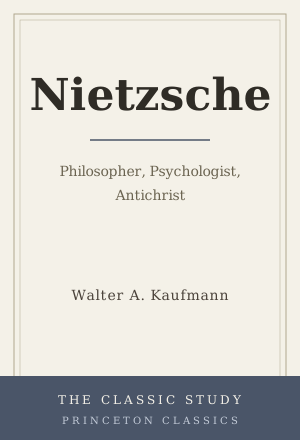
- Title
- Nietzsche: Philosopher, Psychologist, Antichrist (Princeton Classics)
- Author
- Walter A. Kaufmann (foreword: Alexander Nehamas)
- Publisher
- Princeton University Press (Princeton Classics edition, 2013; 4th ed. text)
- Length
- ~560 pp.
- Difficulty
- Intermediate ★★☆ — long, but written to be read
Check price & availability on the Amazon product page
What it is — in three lines
The 1950 study (fourth edition 1974, now a Princeton Classic) that established how the English-speaking world reads Nietzsche: philosopher first, systematic despite the aphorisms, and betrayed rather than represented by the fascist reading. Kaufmann also translated the major works, so the study and the standard translations speak with one voice.
The rescue operation
By 1945, "Nietzsche" meant a Nazi bookshelf ornament. The corruption had a mechanism: his sister Elisabeth — an actual antisemite, which her brother loudly was not — controlled the archive and stitched the fraudulent Will to Power out of rejected notes.
Nietzsche broke with Wagner over antisemitism, and ended his letters to his sister's circle with contempt for the "anti-Semitic canaille."
— the documentary record Kaufmann assembles in chs. 1–2 (editorial summary)
Kaufmann's first two chapters take the forgery apart with receipts; the remaining four hundred pages rebuild what the notes actually support. Reading it is watching philology used as a rescue tool — and it is why every later Nietzsche book, including the friendly paperbacks on this site, can exist.
Three highlights
1. Will to power, de-weaponized
Kaufmann's central argument: the will to power is a psychological principle whose highest form is self-overcoming — power over oneself, not others. Agree or not (scholars still argue), this is the reading that made Nietzsche readable again, and the argument is a pleasure to watch.
2. The psychologist chapters
Ressentiment, bad conscience, the ascetic ideal — treated as discoveries in moral psychology that anticipate Freud. The middle of the book doubles as the best available commentary on On the Genealogy of Morals.
3. A study that reads like advocacy
Kaufmann writes with a stake. The prose has none of the survey-book flatness; it is one strong scholar making one strong case, which is also — fair warning — its bias.
What to watch out for
Two honest notes. First, the scholarship is seventy years old: Kaufmann's gentled, humanist Nietzsche undercorrects in places, and later scholarship pushes back (Nehamas' foreword to this edition maps the debate). Read it as the classic case, not the last word. Second, 560 pages is a real commitment — the Graphic Guide first makes this book faster, not slower. Chapter-by-chapter over two or three weeks is the sane pace.
Check price & availability on the Amazon product page