Home › Top 5 › Thus Spoke Zarathustra
Review: Thus Spoke Zarathustra — read it last, but read it
★★★★★4.5 / 5.0 (editorial rating)
Verdict: the destination of this entire site — and strictly the last stop. "God is dead," the Übermensch, eternal recurrence: every Nietzsche phrase you know originates here, in a philosophy written as poetry and story. Arrive by the ladder above and it reads as the complete version of a story you already know; buy it first and it will defeat you, as it has defeated generations of readers.
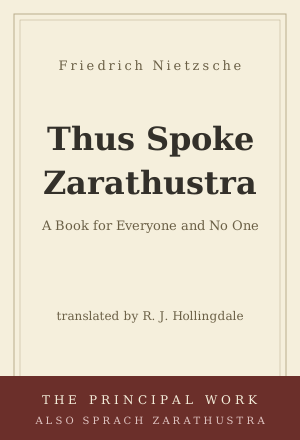
- Title
- Thus Spoke Zarathustra: A Book for Everyone and No One (Penguin Classics)
- Author
- Friedrich Nietzsche, tr. R. J. Hollingdale
- Publisher
- Penguin Classics (1961)
- Length
- 352 pp. (four parts)
- Difficulty
- Advanced ★★★ — the poetic register is the wall
Check price & availability on the Amazon product page
What it is — in three lines
The sage Zarathustra descends from his mountain to teach what life means after the death of God: the Übermensch, the will to power, and — the summit — eternal recurrence. Written in biblical cadences as narrative and song, it is the book Nietzsche considered his masterpiece, and the strangest major work in the philosophical canon.
A map of the four parts
Part I: the Übermensch proposed ("man is something that shall be overcome"). Part II: the will to power unfolded. Part III: the confrontation with eternal recurrence — the summit. Part IV: the higher men tested, and laughter.
— the editorial room's one-line map
Aim for Part III. There the question the whole site has been circling — could you say yes to this exact life, repeated without remainder? — is put to Zarathustra himself, and he answers only after nearly choking on it. Part IV is closer to an epilogue; finish Part III and you may honestly say you have read the book.
Three highlights
1. The prologue's "last man"
Before the Übermensch, Nietzsche shows his opposite: the last man, content with small pleasures, avoiding risk, glad to be like everyone. The first thirty pages contain the most accurate portrait of the scrolling modern ever written in 1883 — proof, on arrival, that this book is in the present tense.
2. "On the Three Metamorphoses"
Camel, lion, child: the whole book in one three-page fable about how a spirit becomes free. If you read only one chapter standing in a bookstore, read this one.
3. The recurrence chapters
"On the Vision and the Riddle" and "The Convalescent" — where the thought Nietzsche called his heaviest is faced rather than stated. Everything the essays and studies told you converges here, and the payoff for climbing the ladder is exactly this: you recognize what is happening.
Where readers stall — and the translations question
The stall is always the same: expecting arguments and meeting poetry. Two remedies. First, carry the map — Kaufmann or the Graphic Guide — so the parables land as positions, not riddles; our sister archive's Zarathustra pages (free, in Japanese) follow the text as well. Second, keep moving: unresolved images resolve downstream. On translations: Hollingdale's Penguin is the standard budget door and our pick for a first pass; Kaufmann's version (in The Portable Nietzsche) and Parkes' Oxford rendering are sound alternatives — any of them will do, and waiting for the perfect translation is just another way of not reading the book.
Check price & availability on the Amazon product page