Review: Introducing Nietzsche: A Graphic Guide — why we shelve a comic next to the classics
★★★★☆3.8 / 5.0 (editorial rating)
Verdict: an illustrated guide, and we recommend it without embarrassment. Will to power, eternal recurrence, ressentiment, the death of God — one idea per spread, drawn and captioned, in about an hour. For anyone who wants the concept map in their head before facing prose — and for anyone whose eyes glaze at the word "epistemology."
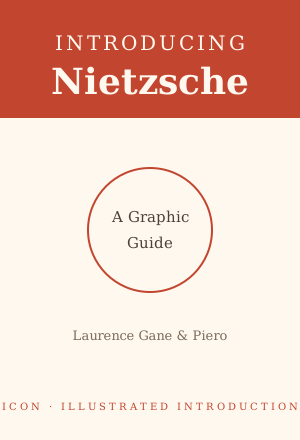
- Title
- Introducing Nietzsche: A Graphic Guide
- Author
- Laurence Gane (text), Piero (illustrations)
- Publisher
- Icon Books (Graphic Guide edition, 2008)
- Length
- 176 pp.
- Difficulty
- Beginner ★☆☆ — about one hour
Check price & availability on the Amazon product page
What it is — in three lines
Icon Books' long-running Graphic Guide on Nietzsche: life and complete conceptual vocabulary, one idea per illustrated spread, from the death of God to the Übermensch to perspectivism. Text by philosopher Laurence Gane, drawings by Piero. Read in an hour, consulted for years.
Why a graphic guide is a legitimate first step
The biggest enemy of a defeated reader is not difficulty but the belief that philosophy is not for them. And Nietzsche's concepts have a property that makes the illustrated format genuinely apt: they are images before they are arguments.
Three metamorphoses of the spirit I name for you: how the spirit becomes a camel; and the camel, a lion; and the lion, finally, a child.
— Nietzsche, Thus Spoke Zarathustra I, "On the Three Metamorphoses" (editorial gloss of the German original)
A philosopher who thinks in camels, lions and children loses less in pictures than almost any other. The Graphic Guide exploits that honestly: each spread plants the image, the caption supplies the claim, and the map builds itself.
Three highlights
1. Full coverage, small package
Unlike most short introductions, nothing major is skipped: the early tragedy book, perspectivism, the genealogy of morals, the sister's misuse of the archive. The proportions are sane — which is precisely what a map is for.
2. The concept-per-spread rhythm
One idea, one image, one page-turn. The rhythm makes revision effortless: flip to the spread, and the whole cluster comes back. It is the reference card you will actually reopen mid-Zarathustra.
3. It takes the ideas seriously
The format is playful; the text is not dumbed down. Gane flags the genuinely contested points — what will to power is a theory of, whether recurrence is cosmology or test — instead of flattening them.
What to watch out for
Plainly: this is scaffolding, not the building. You will not have read Nietzsche when you finish it — you will be equipped to. Captions cannot carry the voice, and the voice is half the philosophy; that half lives in Why I Am So Wise and Zarathustra. Treat any summary — drawn or written — as the map you carry, not the country you visited.
Check price & availability on the Amazon product page