Home › Top 5 › Hiking with Nietzsche
Review: Hiking with Nietzsche — the philosophy, carried up an actual mountain
★★★★☆4.1 / 5.0 (editorial rating)
Verdict: the right first book. A professional philosopher hikes Nietzsche's Alps twice — as a reckless nineteen-year-old and again as a settled father — and lets "become who you are" interrogate his own life. For first contact, and for anyone who wants to know what the ideas are for before learning what they are.
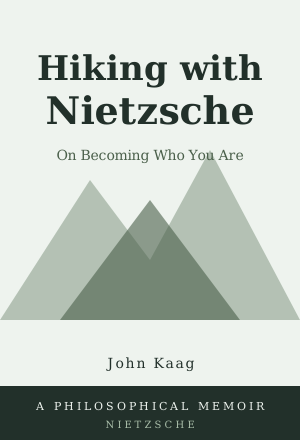
- Title
- Hiking with Nietzsche: On Becoming Who You Are
- Author
- John Kaag (professor of philosophy, UMass Lowell)
- Publisher
- Picador (paperback 2019; FSG hardcover 2018)
- Length
- 272 pp.
- Difficulty
- Beginner ★☆☆ — reads like a memoir, because it is one
Check price & availability on the Amazon product page
What it is — in three lines
At nineteen, philosophy student John Kaag went to Sils Maria — the Swiss village where Nietzsche summered and conceived eternal recurrence — and nearly came apart on the mountains. At thirty-seven he returns with a wife and daughter, hikes the same trails, and asks what "become who you are" means for a man who has become someone. Memoir, travel book and Nietzsche primer braided into one.
Why start with a memoir
Because Nietzsche is the last philosopher who should be met as a list of doctrines. His books are provocations aimed at a reader's life; a systematic summary preserves the propositions and kills the point. Kaag restores the right order — life first, concepts as they bite.
Become who you are.
— Nietzsche, The Gay Science §270 (editorial gloss of the German original)
The book is honest about how strange that imperative is — becoming what you already are? — and shows, through one ordinary life, why the paradox works. That preparation makes everything else on this site read better.
Three highlights
1. Sils Maria, rendered
The landscapes where the ideas were born — the lake, the Waldhaus, the high trails — are drawn well enough that eternal recurrence stops being a classroom puzzle and becomes what it was: a thought that ambushed a walker at a rock by a lake.
2. The two hikes as an argument
Nineteen-year-old Kaag reads Nietzsche as a license for extremity; thirty-seven-year-old Kaag reads him as a discipline for ordinary life. The gap between the two readings is itself the best available commentary on how this philosopher should — and should not — be used.
3. The supporting cast
Schopenhauer, Wagner, Hesse, Adorno — the book quietly delivers a map of Nietzsche's neighborhood, which pays off directly when you reach Kaufmann's study.
What to watch out for
Two honest notes. First, this is a memoir, not a survey: coverage follows Kaag's life, not Nietzsche's system, and the middle-period works get thin treatment. That is what the Graphic Guide and Kaufmann are for. Second, the confessional register — marriage strains, self-destruction, fathers — is the point of the book, but if you want zero autobiography with your philosophy, start at Why I Am So Wise instead.
Check price & availability on the Amazon product page