KANT BOOK GUIDE
The 5 Best Books to Read Kant
——a reading order to the Critique of Pure Reason
Immanuel Kant is the highest peak of modern philosophy — and the hardest. His masterwork, the Critique of Pure Reason, is famous as a book that even philosophy graduates cannot finish on their own. But you don't have to give up. Kant also left short works that any reader can finish — his essay Perpetual Peace among them. Get a map from an introduction, warm up on a short original, walk the argument with a companion, then attempt the summit. Five books, in an order that won't defeat you.
The editorial room also runs sister shops (Descartes, Nietzsche, Schopenhauer) and section-by-section close readings of primary texts, chosen with the same rule: never let a reader pick the wrong first book. All links go to amazon.com.
RankingRANKING
Our recommended order. When in doubt, start at number one. Prices and availability are on the Amazon product page.
-
1
 Start hereEntry
Kant: A Very Short Introduction
Under 150 pocket-sized pages, and the single best map of the whole Kant. Scruton — a serious philosopher who could actually write — lays out the three Critiques and the moral philosophy with unusual clarity. It won't make Kant easy, but it will make him navigable, which is exactly what a first book must do.
Kindle edition available/prices and availability on Amazon
View on Amazon Read the review -
2
 Intermediate
Kant's Critique of Pure Reason: An Introduction
If Scruton maps all of Kant, Buroker zooms in on the summit. A clear, section-by-section introduction to the Critique itself, written for students meeting it for the first time. Read alongside the primary text, it turns a wall of terminology into a followable argument.
Kindle edition available/prices and availability on Amazon
View on Amazon Read the review -
3
 Intermediate
Perpetual Peace and Other Essays
In 1795 Kant sketched the modern international order — standing armies abolished, states made republics, a league of nations — as a set of formal articles. Thin, concrete and readable, this is the book that gives you the experience of finishing a real Kant original. It also collects "What Is Enlightenment?" — his most quoted essay.
Prices and availability on Amazon
View on Amazon Read the review -
4
 Intermediate
Routledge GuideBook to Kant and the Critique of Pure Reason
A companion that walks the Critique in its own order, part by part, explaining the moves as they come. Where Buroker orients you, Gardner accompanies you through the hardest passages — the Deduction, the Antinomies — so that when the primary text stalls, you have a hand to hold. The dress rehearsal before the climb.
Prices and availability on Amazon
View on Amazon Read the review -
5
 Serious
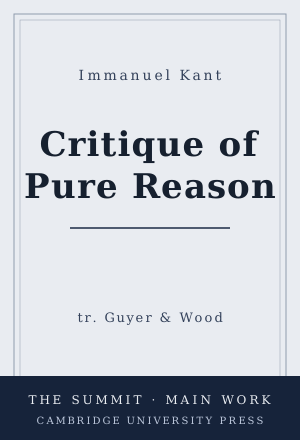
Critique of Pure Reason
"What can I know?" — reason itself put on trial. The summit of modern philosophy, and a months-long climb. The Cambridge edition (Guyer & Wood) is the scholarly standard in English. The four books above exist so that you reach this one prepared — buy it first and you will almost certainly stall.
Prices and availability on Amazon
View on Amazon Read the review
Compare at a glanceCOMPARE
The biggest worry when choosing a philosophy book is "can I actually read this?" Choose by difficulty and format.
| Title | Difficulty | Format / length | Type | Best for | Link |
|---|---|---|---|---|---|
| Kant: A Very Short IntroductionScruton · Oxford | Entry ★☆☆ | ~150 pp ~4 hours |
Introduction (whole Kant) | Want the map of all of Kant, clearly | View on Amazon Review |
| Kant's Critique of Pure Reason: An IntroductionBuroker · Cambridge | Intermediate ★★☆ | ~300 pp ~8 hours |
Guide (to the Critique) | Want a section-by-section orientation to the main work | View on Amazon Review |
| Perpetual Peace and Other Essaystr. Humphrey · Hackett | Intermediate ★★☆ | ~150 pp (thin) ~4 hours |
Primary text (short) | Want to finish one real Kant original first | View on Amazon Review |
| Routledge GuideBook to the CritiqueGardner · Routledge | Intermediate ★★☆ | ~380 pp ~10 hours |
Companion (walks the text) | Want a hand through the hardest passages | View on Amazon Review |
| Critique of Pure ReasonGuyer & Wood · Cambridge | Serious ★★★ | ~800 pp months |
Primary text (main work) | Ready to attempt the summit | View on Amazon Review |
A reading order that won't defeat youROADMAP
There is only one way to fail at Kant: opening the Critique of Pure Reason first. In mountaineering terms it is a winter ascent of the highest peak — not a climb to attempt without a map and a warm-up. Three steps.
-
STEP 1 ── Get the map (first book)
Let Scruton's Very Short Introduction lay out the whole Kant
See how the three Critiques and the moral and political writings fit into one life's project. Get the overview from a clear expert first. If you only care about the Critique of Pure Reason, you can start with Buroker's introduction to it instead.
Scruton's Kant on AmazonRead the review -
STEP 2 ── Warm up on a real original, then rehearse the summit (books 2–4)
Finish Perpetual Peace, walk the Critique with Buroker and Gardner
First earn the success of finishing a genuine Kant text with the thin, concrete Perpetual Peace. Then follow the Critique's argument with Buroker's orientation and Gardner's part-by-part companion, so the primary text is familiar ground before you set foot on it.
Perpetual Peace on AmazonGardner's GuideBook on Amazon -
STEP 3 ── The summit (the goal)
Attempt the Critique of Pure Reason
With the map and the warm-up behind you, begin — and expect to stall. The correct route is a shuttle: read the primary text, and when a passage (the Transcendental Deduction, the Antinomies) blocks you, return to Gardner, then climb again. Give it months, not days. Reaching the top of this one is a genuine achievement.
The Critique on AmazonRead the review
How we choseCRITERIA
Five criteria. First, currently in print and available on amazon.com — every title has a live product page from an established publisher (Oxford, Cambridge, Hackett, Routledge). Second, the ladder must hold: overview → a short real original → companion → the main work, each step preparing the next. Third, the primary texts are chosen for accessibility of entry (the thin Perpetual Peace before the vast Critique). Fourth, each guide's character (whole-Kant map, introduction to the Critique, part-by-part companion) is stated in its review. The editorial room runs sister shops and section-by-section close readings of primary texts, and selects with the same rule throughout. Star ratings are our own; the basis (first-hand reading and bibliographic research) is stated in each review. On translations of the Critique, the Cambridge (Guyer & Wood) is our default; the Kemp Smith, Pluhar (Hackett) and Weigelt (Penguin) versions are also on amazon.com, and each review notes the choice.
If you only buy oneCONCLUSION
If you've read this far and still can't decide, the answer is simple. Buy Scruton's Kant: A Very Short Introduction. You cannot climb the Critique without a map, and this is the best map there is — short enough to read in an afternoon, serious enough to trust. Get the overview, and the rest of the ladder tells you where to step. Only if you are certain you want the summit itself should you start anywhere else.
Prices and availability are on the Amazon product page.