Home › Top 5 › Perpetual Peace and Other Essays
Perpetual Peace review — the Kant original you can actually finish
★★★★☆4.4 / 5.0 (our rating)
Verdict: The warm-up that makes the summit possible. Thin, concrete and genuinely readable, Perpetual Peace is the Kant original a beginner can finish in an afternoon — and finishing a real Kant text, once, changes how the harder ones feel. This Hackett volume also gathers his most famous short essay, "What Is Enlightenment?"
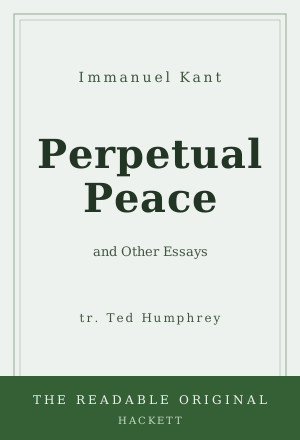
- Title
- Perpetual Peace and Other Essays
- Author
- Immanuel Kant (tr. Ted Humphrey)
- Publisher
- Hackett Publishing
- Format
- ~150 pp (thin)
- Difficulty
- Intermediate ★★☆ — about 4 hours
Prices and availability on Amazon
What it is — in three lines
In 1795 Kant wrote a short political essay in the mock form of a peace treaty, complete with "Preliminary Articles" and "Definitive Articles." This Hackett edition (tr. Ted Humphrey) prints it with several other short pieces — most importantly "An Answer to the Question: What Is Enlightenment?" It is Kant at his most public and concrete.
Why start your originals here
The reason this book sits in the middle of the ladder is strategic. The Critique of Pure Reason is so long and so abstract that a reader can spend weeks in it without the satisfaction of having finished anything — and that lack of a win is what breaks people. Perpetual Peace gives you the win: a complete, self-contained Kant text you can read to the end, in his own voice, arguing about something tangible (war, republics, world order). Once you have done that, the first Critique is no longer "a Kant book I'll never finish" but "a longer Kant book" — a difference of kind, in your own head, that matters more than any technique.
Three things to look for
1. The "Definitive Articles"
Republican constitutions, a federation of free states, a right of universal hospitality — Kant is sketching, in 1795, the logic behind the League of Nations and the UN. Reading the blueprint at the source is a small thrill.
2. "What Is Enlightenment?"
Sapere aude — "dare to know." Kant's definition of enlightenment as humanity's release from self-imposed immaturity is six pages that everyone quotes and few have read. Here you can.
3. Kant being readable
These essays show that the difficulty of the Critiques is a feature of their subject, not of Kant's pen. That is oddly encouraging when you turn to the hard books.
One caveat
Don't mistake the accessibility for the whole of Kant. This is the political and popular Kant; the theoretical machinery that makes him the giant of modern philosophy is in the Critiques, not here. Take Perpetual Peace as a confidence-builder and a genuine pleasure — then go where the real difficulty (and the real reward) is, with Scruton and Buroker as your guides.
Prices and availability are on the Amazon product page.