Home › Top 5 › Buroker, An Introduction
Kant's Critique of Pure Reason: An Introduction review — the orientation to the summit
★★★★☆4.3 / 5.0 (our rating)
Verdict: The book to read once you know you're heading for the Critique. Where Scruton maps all of Kant, Buroker zooms in on the first Critique and takes it section by section, in the plain, careful voice of a good seminar leader. Read next to the primary text, it converts a wall of technical terms into an argument you can actually follow.
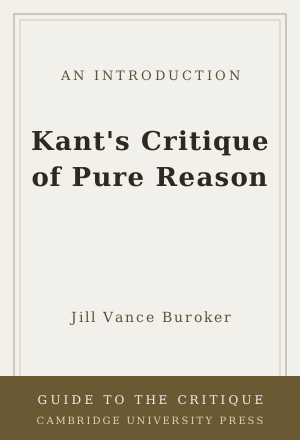
- Title
- Kant's Critique of Pure Reason: An Introduction
- Author
- Jill Vance Buroker
- Publisher
- Cambridge University Press
- Format
- ~300 pp
- Difficulty
- Intermediate ★★☆ — about 8 hours
Kindle edition available/prices and availability on Amazon
What it is — in three lines
Part of Cambridge's "Introductions to Key Philosophical Texts," Jill Vance Buroker's book is a chapter-by-chapter guide to the Critique of Pure Reason aimed at students and serious first-time readers. It follows the structure of the work — Aesthetic, Analytic, Dialectic — and explains each stage in current, jargon-controlled English.
Orientation vs. companion
This shelf gives you two guides to the Critique on purpose, because they do different jobs. Buroker's is orientation: read mostly before and around the primary text, it gives you the shape of the whole argument and the meaning of the key terms, so you arrive knowing what an "intuition," a "category," and the "transcendental" are before Kant starts using them at speed. (Gardner's Routledge GuideBook is the other kind — a companion to read passage by passage with the text.) Start with Buroker to get the lay of the land; keep Gardner open when you climb.
Three things to look for
1. The treatment of the Transcendental Deduction
Buroker is unusually clear on the book's central and hardest argument, laying out what Kant is trying to show and why it is so difficult. This chapter alone earns the book its place.
2. Terminology under control
She defines Kant's vocabulary as it arises and reuses it consistently, which is exactly the discipline a beginner needs and many guides lack.
3. It respects the text's order
Because it tracks the Critique's own sequence, you can read a section of Kant and then the matching pages here without losing your place.
One caveat
It is a scholarly introduction, not a gentle popularisation — pitched at university level, so it assumes you are serious and will meet some genuine argument. That's the right pitch for someone genuinely aiming at the Critique, but if you want an easier on-ramp first, take Scruton and Perpetual Peace before this.
Prices and availability are on the Amazon product page.