Home › Top 5 › Gardner, Routledge GuideBook
Routledge GuideBook to the Critique review — the companion for the hardest passages
★★★★☆4.3 / 5.0 (our rating)
Verdict: The book to keep open while you climb. Sebastian Gardner's GuideBook follows the Critique in its own order, part by part, explaining each move as it arrives. Where Buroker orients you before the ascent, Gardner walks beside you through the passages that stop everyone — the Transcendental Deduction, the Antinomies. It is the dress rehearsal, and then the rope, for the summit.
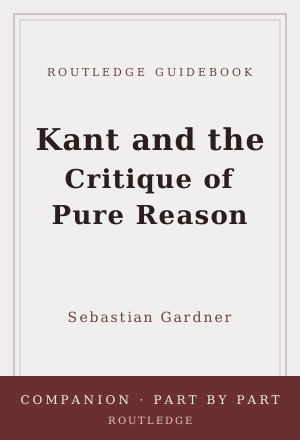
- Title
- Routledge Philosophy GuideBook to Kant and the Critique of Pure Reason
- Author
- Sebastian Gardner
- Publisher
- Routledge
- Format
- ~380 pp
- Difficulty
- Intermediate ★★☆ — about 10 hours
Prices and availability on Amazon
What it is — in three lines
Part of Routledge's GuideBook series, Sebastian Gardner's volume is a full-length commentary that moves through the Critique of Pure Reason in sequence, from the Aesthetic to the Dialectic and the Doctrine of Method. Gardner is a serious Kant scholar (UCL), and the book is widely set as the accompanying commentary on university courses on the first Critique.
A companion, not an overview
The distinction from Buroker is the whole point of having both. Buroker gives you the shape of the argument from above; Gardner gets down into the text and takes it passage by passage. When Kant's Transcendental Deduction folds back on itself, or the Antinomies seem to prove both sides of a contradiction, Gardner is there at that exact page, reconstructing the argument and flagging where the scholarly disputes lie. This is why it belongs in your hand during the climb, not before it: read a stretch of Kant, then read Gardner on the same stretch, and the fog lifts by a degree each time. It is the closest thing to a guided ascent of the Critique.
Three things to look for
1. The Transcendental Deduction chapters
The single hardest thing in the book gets Gardner's most patient treatment — the reconstruction of what Kant is proving, and how, that most readers need to make it through.
2. Honest about the disputes
Gardner marks where interpreters disagree rather than pretending the text is settled. That honesty is reassuring: when you find a passage baffling, it is often genuinely contested.
3. It tracks Kant's sequence
Because it follows the Critique's own order, you can shuttle between the two without losing your place — the mechanic our reading order is built around.
One caveat
It is demanding in its own right — a scholarly commentary, not a hand-holding paraphrase, and it assumes you are reading the primary text alongside it. On its own it is dry; used with the Critique it is invaluable. Don't try to read Gardner cover-to-cover in the abstract; deploy it passage by passage where you are stuck.
Prices and availability are on the Amazon product page.