Home › Top 5 › The Death of Ivan Ilyich
Review: The Death of Ivan Ilyich — a well-ordered life, undone at the end
★★★★☆4.1 / 5.0 (editorial rating)
Verdict: if you want to live death as a story rather than an argument, this short novel is the one. A judge who has done everything the world calls "correct" falls ill, and — forced to face death — is dropped into the question "was my life ever really my own?" Not philosophy, not medicine, but the interior of one ordinary man's dying, rendered whole by one of literature's greatest novelists. A brief, plain, unforgettable classic.
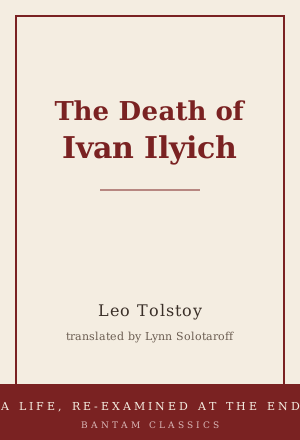
- Title
- The Death of Ivan Ilyich (Bantam Classics)
- Author
- Leo Tolstoy, tr. Lynn Solotaroff
- Publisher
- Bantam Classics
- Type
- Literature (a short novel / novella)
- Difficulty
- Intermediate ★★☆ — the prose is plain; the subject is heavy (~2 hrs)
Check price & availability on the Amazon product page
What it is — in three lines
Leo Tolstoy, the author of War and Peace and Anna Karenina, wrote this short novel (1886) in his later years, out of his own struggle with the fear of death. It opens with the news of the protagonist's death and then winds time back to trace how he lived, how he sickened, and how he died. In under two hours of reading, it does what a treatise cannot: it puts you inside a dying man.
The core — the question of a "correct" life
Ivan Ilyich has climbed the ladder, built a respectable household, and lived, by every external measure, "properly." Then an obscure illness lays him low, and as death becomes undeniable, what torments him most is not the physical pain but the doubt: "I lived as I was supposed to — so why is it all so empty? Could it be that my whole life was wrong?"
Ivan Ilyich's life had been most simple and most ordinary and therefore most terrible.
— Leo Tolstoy, The Death of Ivan Ilyich (a famous line, in standard English renderings)
Around him, everyone behaves as though his dying were not happening, hiding behind formal sympathy while calculating their own affairs; only the servant Gerasim offers him simple, honest kindness. Through that contrast Tolstoy holds up, in the light of death, the difference between living for appearances and really living. Where the novel finally arrives — which we will not spoil — leaves a quiet question hanging over the reader's own life.
Three highlights
1. An opening that shows death as someone else's problem
The story begins with colleagues receiving the news — and their real feelings are relief that it was not them, and calculation about the vacant post. Tolstoy renders, without mercy, how the living hold death at arm's length. Read alongside Yalom on how death anxiety hides behind other concerns, it cuts even sharper.
2. The loneliness of the dying
No one will admit he is dying, and he can hardly admit it himself; the loneliness that deepens inside that mutual lie is one of literature's truest portraits of the silence around death — the same silence Gawande works to break at the bedside.
3. A short, plain door in
It is brief and, in a good current translation, unforced modern English without the forbidding surface of "a classic." Because the prose is plain, you can give your whole attention to the weight of what it carries. A fair first Russian novel, too.
What to watch out for
Two honest notes. First, this is a novel, not a study. If what you want is organized knowledge about death, Kagan and Gawande serve better; the value here is re-living, not information. Second, the portrayal of the protagonist's suffering is unsparing, and for anyone in the middle of illness, or who has just sat with a dying relative, the identification can become very strong. It is a short book, but read it gently, and not before you are ready.
Check price & availability on the Amazon product page