Home › Top 5 › Staring at the Sun
Review: Staring at the Sun — the fear of death, and easing it
★★★★☆4.0 / 5.0 (editorial rating)
Verdict: the bridge between the argument and the feeling. A psychotherapist of half a century writes about the anxiety of death that quietly steers how we live — and how it can be met. Yalom carries Epicurus's old arguments out of the seminar and into the consulting room, and adds his own idea of "rippling." Where Kagan reasons and Gawande reports, Yalom tends to the fear itself.
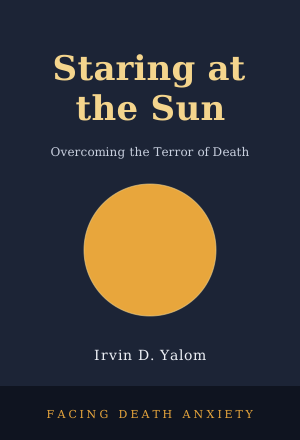
- Title
- Staring at the Sun: Overcoming the Terror of Death
- Author
- Irvin D. Yalom (emeritus professor of psychiatry, Stanford)
- Publisher
- Jossey-Bass
- Type
- Existential psychology / psychotherapy
- Difficulty
- Intermediate ★★☆ — warm and readable, but philosophically substantial (~7 hrs)
Check price & availability on the Amazon product page
What it is — in three lines
Irvin D. Yalom is one of the founders of existential psychotherapy and, in his eighties when he wrote this, a clinician who had spent a career with dying and grieving patients. Staring at the Sun is his book about the fear of death — how it hides behind other anxieties, surfaces at midlife and in loss, and can be worked with rather than merely suffered. It blends case stories, philosophy, and his own frank reckoning with his own mortality.
The core — death anxiety, and what eases it
Yalom's starting point is that much of our ordinary unease is death anxiety wearing a disguise. His remedy is not denial but a fuller turning-toward — "staring at the sun" — and here he leans on the same Epicurus that Kagan examines, using the ancient arguments as therapy rather than as logic. He takes up the symmetry argument in particular: the state of non-existence after death is no different from the non-existence before our birth, which did not trouble us.
Though the physicality of death destroys us, the idea of death saves us.
— Irvin D. Yalom, Staring at the Sun (Jossey-Bass)
To that he adds his own contribution, "rippling": the recognition that each of us sends out concentric circles of influence — in people, in acts, in ideas — that go on after we are gone. Not a promise of literal survival, but a source of meaning that, in his clinical experience, genuinely loosens the grip of terror. It is the most consoling book on this shelf without being a false comfort.
Three highlights
1. Epicurus in the consulting room
The philosophical arguments Kagan sets out as logic, Yalom puts to work as therapy — testing whether they actually reach a frightened person. Reading the two together shows the same ideas from two sides: the seminar and the clinic.
2. "Rippling" as a workable idea
Rippling gives readers something to do with the fear rather than merely understand it. It reframes a life's meaning as its effects on others — an idea that survives scrutiny and still helps.
3. A therapist who shows himself
Yalom writes openly about his own aging and fear, and about awakening experiences — moments, often brushes with death, that jolt people into living more fully. The self-disclosure is what makes the counsel land.
What to watch out for
Two honest notes. First, this is a psychotherapist's book, not a rigorous philosophy of death: Yalom uses the arguments instrumentally, for their effect on a patient, and a reader who wants them examined for validity should pair it with Kagan. Second, its register is consoling and self-disclosing; if you want your thinking about death with no therapy attached, that warmth may feel like more hand-holding than you were after. In that case, start from the colder clarity of Kagan and treat Yalom as the companion for the feeling.
Check price & availability on the Amazon product page