Home › Top 5 › When Breath Becomes Air
Review: When Breath Becomes Air — a dying physician's testimony
★★★★☆4.2 / 5.0 (editorial rating)
Verdict: the book that makes the argument concrete. A neurosurgeon who had spent his career at the border of life and death is diagnosed, at thirty-six, with terminal cancer — and writes, while dying, about what makes a life worth living when the time left is short. Not a treatise but a testimony. After the philosophy, the medicine, and the psychology, this is where the subject becomes a single unbearable human face.
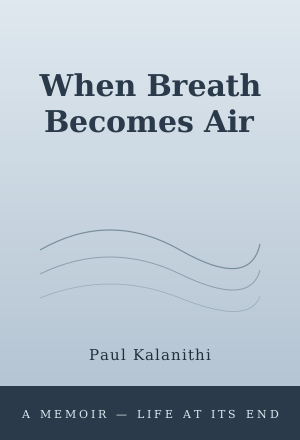
- Title
- When Breath Becomes Air
- Author
- Paul Kalanithi (neurosurgeon; 1977–2015)
- Publisher
- Random House
- Type
- Memoir (with a foreword by Abraham Verghese and an epilogue by Lucy Kalanithi)
- Difficulty
- Beginner ★☆☆ — plain and swift to read, deeply affecting (~4 hrs)
Check price & availability on the Amazon product page
What it is — in three lines
Paul Kalanithi trained for years as a neurosurgeon — a doctor whose daily work put him at the exact seam between a life and its ending — and had also studied literature, drawn to the question of what makes a life meaningful. Near the end of that training he was diagnosed with terminal lung cancer. When Breath Becomes Air is the book he wrote in the time that remained, moving from the physician's side of that seam to the patient's. He did not live to finish it; his wife, Lucy, completed it with an epilogue.
The core — meaning when time runs short
The question that had drawn Kalanithi to both medicine and books becomes, in his own illness, unavoidable: if I have ten years, I might build a career; if I have one, I would spend it differently — so who am I, and what should I do, now that I do not know which it is? He and Lucy also decide, in the shadow of his diagnosis, to have a child. The book is his attempt to answer, honestly and without consolation, what a good life is when its length has been taken out of your hands.
You filled a dying man's days with a sated joy, a joy unknown to me in all my prior years, a joy that does not hunger for more and more, but rests, satisfied.
— Paul Kalanithi, When Breath Becomes Air (his words to his infant daughter)
What keeps the book from sentimentality is the doctor's exactness Kalanithi brings to his own case — he knows the statistics, the scans, the odds — set against a writer's care for what the numbers cannot hold. It is short, and it is the most direct answer on this shelf to the question the other four books circle.
Three highlights
1. Both sides of the seam
Kalanithi writes first as the surgeon delivering diagnoses, then as the patient receiving one. That crossing — the same person on both sides of the news — is what makes the book a rare document, and a companion piece to Gawande's Being Mortal seen from the bed rather than the bedside.
2. Literature as a tool for dying
He turns to writers and poets not for comfort but for language equal to the situation — a demonstration of why the literary door onto death, which Tolstoy opens next, matters at all.
3. The unfinished book, and Lucy's epilogue
The book stops where his life did; Lucy's closing pages carry it the rest of the way. That the work is literally incomplete is part of what it has to say about a life cut short — and it is handled with great restraint.
What to watch out for
Two honest notes. First, this is one person's memoir, not a general account of death or of illness; its truth is a testimony, not a framework, and for the framework you want Kagan or Gawande. Second, and plainly: it is very moving, and can be hard to bear, especially for readers living with serious illness or recent loss — a young family, a young death. It is short, but do not push through it if it is too near. Read it when you are ready.
Check price & availability on the Amazon product page