Review: Being Mortal — when medicine meets the end
★★★★☆4.3 / 5.0 (editorial rating)
Verdict: the book that brings death down from the seminar to the bedside. A practicing surgeon looks squarely at how modern medicine has chased length of life and left "how we want to live at the end" behind — through the stories of his patients and his own father's dying. Longevity or quality of life? How is a person's autonomy to be protected? Not as abstraction, but as narrative — which is why the questions land so hard.
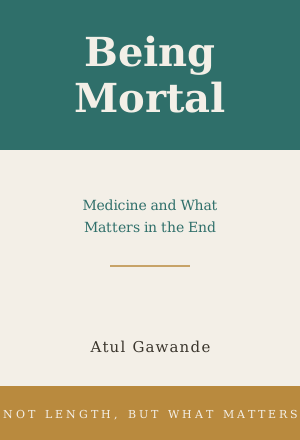
- Title
- Being Mortal: Medicine and What Matters in the End
- Author
- Atul Gawande (surgeon; professor, Harvard Medical School)
- Publisher
- Picador (paperback); Metropolitan Books (hardcover)
- Type
- Nonfiction / medical narrative
- Difficulty
- Beginner ★☆☆ — plain and gripping, but emotionally heavy (~7 hrs)
Check price & availability on the Amazon product page
What it is — in three lines
Atul Gawande is a surgeon and a widely read essayist on medicine. In Being Mortal he turns on his own profession the question it is trained to avoid: as bodies fail with age and illness, medicine reaches for one more procedure, one more month — and often loses sight of the life the patient actually wants to be living. Reporting from nursing homes, hospice, and his father's own final illness, he asks what medicine is for at the end.
The core — a good life to the very end
Gawande's argument is not against medicine but against a narrowed idea of its goal. When length of life becomes the only measure, patients are subjected to treatments that buy time at the cost of everything that made the time worth having. The alternative he presses for is to ask, plainly, what a person's priorities are when time is short — and then to serve those, even when that means less treatment rather than more. Hospice, in his telling, is not giving up; it is a different, often better, way of using the days that remain.
Our ultimate goal, after all, is not a good death but a good life to the very end.
— Atul Gawande, Being Mortal (Metropolitan Books)
Around that sentence the book gathers a set of hard, practical questions — what are you afraid of, what are your hopes, what trade-offs are you willing to make — that turn "how do we die well" into "how do we live well while dying." It is the most usable book on this shelf for anyone facing these choices for a parent, a partner, or themselves.
Three highlights
1. Autonomy versus safety
Gawande's chapters on assisted living and nursing homes show how easily institutions trade an old person's autonomy for the institution's idea of safety — and what it costs the person to be kept safe and unfree. It reframes "care" as a question about whose life it is.
2. The questions that change a conversation
Much of the book's practical power is in a handful of questions doctors and families can ask before the last crisis, not during it. Naming what a patient fears and hopes for turns out to change what medicine should do — a small, transferable tool the reader carries out of the book.
3. His own father's death
The reporting becomes personal when Gawande's father, also a surgeon, is dying. Watching a man who knows medicine make these choices for himself keeps the book honest: this is not advice from the outside, but a son's account from within.
What to watch out for
Two honest notes. First, this is reportage and argument, not a philosophical analysis of what death is; for that spine, read Kagan first. Its strength is the concrete — which means, second, that the patient stories can be very close to the bone. If you are currently caring for someone at the end of life, or have recently lost someone, some chapters may hit hard. It is worth reading, but read it at your own pace.
Check price & availability on the Amazon product page