Review: Death by Shelly Kagan — reasoning it out, one step at a time
★★★★☆4.4 / 5.0 (editorial rating)
Verdict: the first book on death to read. Built on the Yale course that ran for years, it works through "what is death," "what is bad about death," and "would immortality be desirable" — leaning on neither religion nor the supernatural, but on the tools of analytic philosophy, one step at a time. It does not push an answer on you; it hands you the instruments to think. That is exactly why it belongs first.
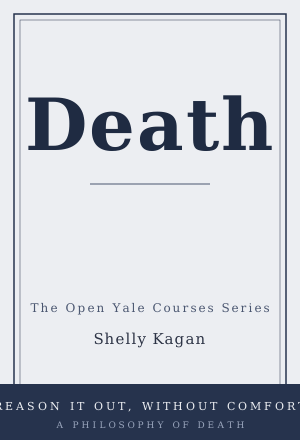
- Title
- Death (The Open Yale Courses Series)
- Author
- Shelly Kagan (Clark Professor of Philosophy, Yale)
- Publisher
- Yale University Press
- Type
- Analytic philosophy (based on a lecture course)
- Difficulty
- Beginner ★☆☆ — no prior knowledge needed; long, but a gentle climb (~10 hrs)
Check price & availability on the Amazon product page
What it is — in three lines
Shelly Kagan is a professor of philosophy at Yale, and this book grew out of his long-running, wildly popular course simply titled "Death." Does the soul exist? What is personal identity? Is death really bad? Would immortality be a blessing? Can suicide ever be rational? He takes up each question in turn and examines it not with feeling or faith but with argument and counter-example. It is not a book that gives you answers; it is a book that trains the way you think.
The core — what is bad about death?
The spine of the book is a question that looks simple and turns out to be hard: if death is bad for me, whose badness is it, and when? Once I am dead, I no longer exist — and can anything be bad for someone who does not exist? The ancient Epicurus argued that death is nothing to us: while we exist, death is not; when death comes, we are not.
Death is nothing to us; for while we exist, death is not present, and when death is present, we no longer exist.
— Epicurus, Letter to Menoeceus (standard rendering; the argument Kagan takes up head-on)
Kagan does not brush this aside. He takes the Epicurean challenge seriously and then builds the case that death can still be bad, through the deprivation account: death is bad not because of anything it contains, but because it deprives us of the goods we would have had if we had gone on living. Along the way the reader discovers that the vague feeling "death is frightening / bad" was in fact a bundle of several distinct claims. The book does not deny your fear; it itemizes it — and that is its effect.
Three highlights
1. The honesty of starting from "there is no soul"
In the first half Kagan examines the idea of a soul that survives death and concludes there is no good reason to believe in one — a physicalist position he states plainly. Fixing that premise early is what sharpens the second half: if death is just the body ceasing to function, then precisely what is the problem? He never hides his own view, and gives real space to the objections.
2. The reversal: is immortality actually good?
We tend to think "if only we didn't have to die." The book asks the question the other way: would living forever be desirable? Consider the tedium and the weight of an endless life, and immortality stops looking like a simple rescue. Doubting immortality before mourning mortality gives the whole subject depth.
3. Long, but a staircase you can climb
It is a big book, but each chapter is a short stack of arguments, and the lecture voice lets you take the stairs one at a time. It does not pile up jargon; it moves by everyday examples and counter-examples, so a reader new to philosophy is not left behind.
What to watch out for
Two honest notes. First, this is written in the analytic style, and it is not a "book that sits with your heart." In the middle of grief, when what you want is consolation, its rigor can feel cold. If that is where you are, it may be better to enter through Yalom's Staring at the Sun or the literature of Tolstoy first. Second, it is long. Rather than resolving to read every page, it is entirely legitimate to read into the chapter on whatever question is actually snagging you — the badness of death, immortality, the rationality of suicide.
Check price & availability on the Amazon product page