Home › Top 5 › What the Buddha Taught
Review: What the Buddha Taught — the standard first book, and it earns it
★★★★★4.7 / 5.0 (editorial rating)
Verdict: the book to read first, with almost nothing to argue about. A hundred and fifty clear pages that state the core teaching honestly — and then hand you the actual texts. Rahula explains the four noble truths, no-self and the path in plain language, and appends his own translations from the Suttas and the Dhammapada, so a single small volume is both the explanation and your first taste of the sources.
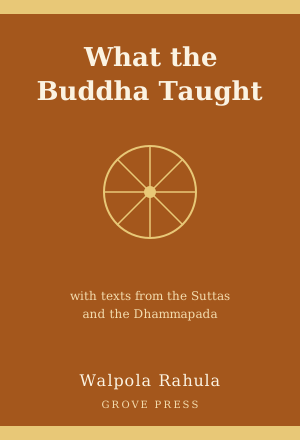
- Title
- What the Buddha Taught (Revised & Expanded, with texts from the Suttas and Dhammapada)
- Author
- Walpola Rahula
- Publisher
- Grove Press (revised ed.; first published 1959)
- Length
- Doctrinal primer + selected texts · ~151 pp.
- Difficulty
- Beginner–Intermediate ★★☆ — plain prose, but real doctrine
Check price & availability on the Amazon product page
What it is — in three lines
Walpola Rahula (1907–1997) was a Sri Lankan Buddhist monk trained in the Theravada tradition and a university scholar of the field. First published in 1959, his book distils the fundamentals of the Buddha's teaching — the four noble truths, the doctrines of no-self (anatta) and conditioned arising, meditation, and the practice of the teaching in daily life — into about eight short chapters. The revised edition then adds an anthology of illustrative passages, translated by Rahula himself, from the Pali Suttas and the Dhammapada. A primer and a small reader in one.
Why it's the right first book
The reason is its unusual double nature. Most introductions summarise the teaching and stop; most anthologies drop you into the texts with too little scaffolding. Rahula does both, briefly and in order — he tells you what a doctrine claims, then shows you the passage where the Buddha states it. Because the author is both a traditionally trained monk and a modern scholar, the explanation is faithful to the tradition without being devotional, and precise without being technical.
The Buddha was a human being. He claimed no inspiration from any god or external power. He attributed all his realization, attainments and achievements to human endeavour and human intelligence.
— Walpola Rahula, What the Buddha Taught, ch. 1 (widely quoted)
You can read it in an evening or two, yet you close it holding the actual framework of early Buddhist thought rather than a mood or a set of slogans. For a subject this large, that ratio of brevity to substance is rare.
Three highlights
1. The four noble truths, without the fog
Rahula's chapters on the truths of dukkha and its cessation are models of clarity. He heads off the common mistranslation of dukkha as mere "suffering," and explains the third truth — cessation — as something positive rather than bleak. This alone corrects most beginners' first misunderstandings.
2. No-self, explained rather than mystified
The doctrine of anatta is where most newcomers get lost. Rahula takes it slowly and argues it from the texts, so that a genuinely difficult idea arrives as an argument you can follow, not a riddle you must simply accept.
3. The anthology at the back
The selected passages — including parts of the first sermon and verses from the Dhammapada — mean you finish the book having read some of the primary sources directly, in a careful translation, and are ready for a fuller anthology.
What to watch out for
Two honest notes. First, Rahula writes primarily from the Theravada tradition and from the Pali sources; it is an excellent account of early and Theravada Buddhism, not a survey of the later Mahayana and Tibetan developments — for that wider frame, go on to The Foundations of Buddhism. Second, the prose is plain but the ideas are real philosophy; if you would like the lay of the land before you start, an afternoon with Keown's Very Short Introduction makes the doctrine here easier to place.
Check price & availability on the Amazon product page