Home › Top 5 › In the Buddha's Words
Review: In the Buddha's Words — the Pali discourses, made navigable
★★★★★4.7 / 5.0 (editorial rating)
Verdict: the primary source, with a guide beside you. Bhikkhu Bodhi selects discourses from the Pali Canon and arranges them into ten themed chapters, each opened by a clear introduction that tells you where you are and why it matters. It is the closest an English reader can get to reading the earliest record of the Buddha's teaching directly — without drowning in it.
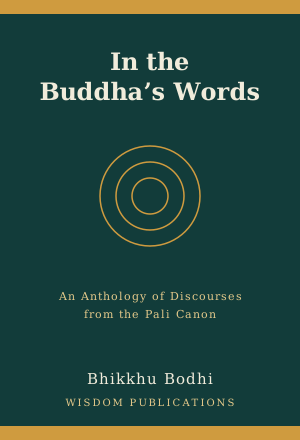
- Title
- In the Buddha's Words: An Anthology of Discourses from the Pali Canon
- Editor / translator
- Bhikkhu Bodhi (foreword by the Dalai Lama)
- Publisher
- Wisdom Publications (2005)
- Length
- Primary anthology (guided) · ~512 pp.
- Difficulty
- Intermediate ★★☆ — primary texts, but well signposted
Check price & availability on the Amazon product page
What it is — in three lines
Bhikkhu Bodhi is an American-born Theravada monk and one of the foremost modern translators of the Pali Canon — the collection of discourses (suttas) preserved by the Theravada tradition as the earliest record of the Buddha's teaching. Here he draws from that vast body of texts and organises the selections into ten thematic chapters, moving from the human condition and the good life through renunciation, the path of practice, and the goal of liberation. Each chapter opens with a substantial introduction of his own, so the reader is never dropped into a text without orientation.
Why this is how to read the sources
The Pali Canon is enormous and was not written to be read front to back; opening a full volume of discourses cold is how most readers give up. Bodhi solves this. His thematic arrangement turns a library into a course: the chapters build on one another, the introductions supply the doctrinal and historical frame, and the selected discourses let you hear the teaching in its own repetitive, formulaic, strangely hypnotic voice. This is the payoff of the whole roadmap — after the overview, the life and the primer, you finally read the words themselves, and you are ready for them.
The translations are careful and consistent, and the apparatus — introductions, notes, a guide to the canon — makes the book usable as a reference long after a first reading.
Three highlights
1. The chapter introductions
Bodhi's essays before each section are worth the price on their own: they are a lucid, source-grounded account of the teaching that doubles as a map of the canon.
2. The thematic progression
Beginning with everyday life and ethics before ascending to renunciation and insight means the demanding material arrives only once you are prepared for it.
3. The authentic texture of the suttas
You meet the discourses' actual style — the set phrases, the repetitions, the frame stories — which no paraphrase conveys, and which is itself part of understanding how the teaching was remembered and transmitted.
What to watch out for
Two honest notes. First, this is an anthology of the Pali (Theravada) canon specifically; it is the earliest stratum, but it is not the whole of Buddhist scripture, and it does not represent the later Mahayana sutras — Gethin's Foundations sets that wider textual history in place. Second, primary texts, even well introduced, reward patience: read a chapter at a time, lean on the introductions, and do not expect the narrative momentum of a biography. If you have not yet read a doctrinal primer, do Rahula's What the Buddha Taught first.
Check price & availability on the Amazon product page