Home › Top 5 › Buddha (Karen Armstrong)
Review: Buddha by Karen Armstrong — the life, read honestly
★★★★☆4.2 / 5.0 (editorial rating)
Verdict: the human story that makes the teaching land — with its own honesty about the sources built in. Armstrong places Siddhartha Gautama in the religious ferment of ancient India and follows him from the sheltered palace to the awakening and forty-five years of teaching, while telling you plainly that no documentary biography of the Buddha is possible. A life, read as the tradition tells it.
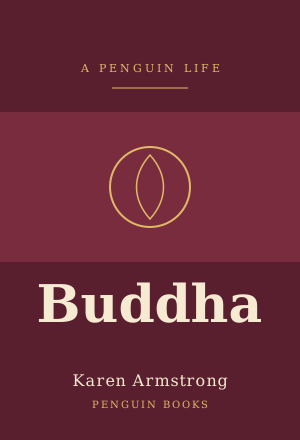
- Title
- Buddha (Penguin Lives)
- Author
- Karen Armstrong
- Publisher
- Penguin Books (Penguin Lives series; first published 2001)
- Length
- Biography / life · ~240 pp.
- Difficulty
- Beginner ★☆☆ — narrative, very readable
Check price & availability on the Amazon product page
What it is — in three lines
Karen Armstrong is one of the most widely read writers on religion in English, a former nun turned historian of faith. Her contribution to the Penguin Lives series of short biographies tells the life of the Buddha — birth into the Shakya clan, the great renunciation, the years of ascetic striving, the awakening at Bodh Gaya, and the long teaching career — set firmly within the axial age ferment of sixth-century-BCE north India. A short, shapely narrative life.
Why the life comes second
The discourses were not spoken into a void; they answered the questions of a particular society in a particular century. Armstrong's real subject is that context — the world of wandering renunciants, competing teachers and new ideas about suffering and release — and how one life took shape inside it. Read after the overview and before the teaching, it gives the doctrines a face and a setting, so the four noble truths read as one person's hard-won answer rather than an abstract list.
Crucially, Armstrong is candid about her materials. She does not pretend to a modern biographer's certainty; she works from traditional accounts written down long after the events and tells the reader so. That honesty is exactly what a beginner needs, because it models how to read a religious life without either credulity or dismissal.
Three highlights
1. The axial age frame
Armstrong's specialty is setting a religious founder in the wider spiritual upheaval of his era. Here it pays off: you see why renunciation and the search for release were live questions across ancient India, not eccentricities of one man.
2. The renunciation, told as a human turning point
The famous leaving of the palace becomes a decision with weight and cost, not a fairy tale — which makes the awakening that follows feel earned.
3. Its built-in humility about the evidence
The book keeps reminding you that this is a life reconstructed from tradition. Far from a weakness, it is the most useful lesson a first biography can teach.
What to watch out for
Two honest notes. First, this is a work of interpretation, not a chronicle: Armstrong reads the sources through a strong thematic lens (the axial age, the psychology of faith), and other scholars would frame the same evidence differently — treat it as a compelling reading, not the last word. Second, it is a life, not a systematic account of the doctrine; for that, go to Rahula's What the Buddha Taught, and for the source-critical scholarship, to Gethin's Foundations.
Check price & availability on the Amazon product page