Home › Top 5 › Buddhism: A Very Short Introduction
Review: Buddhism — A Very Short Introduction — get your bearings first
★★★★☆4.5 / 5.0 (editorial rating)
Verdict: the most efficient way to orient yourself before anything longer. Under two hundred pages that lay out the Buddha, the core doctrines, karma and rebirth, meditation and the major schools — briskly, accurately, and without jargon. Read this and nothing in the primary sources will blindside you.
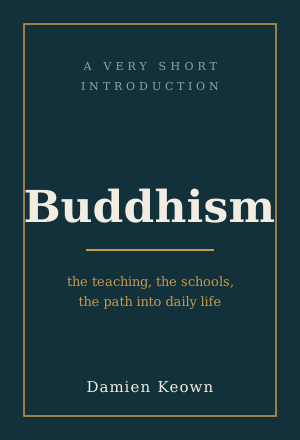
- Title
- Buddhism: A Very Short Introduction
- Author
- Damien Keown
- Publisher
- Oxford University Press (2nd ed., 2013)
- Length
- Scholarly introduction · ~187 pp.
- Difficulty
- Beginner ★☆☆ — short, clear, comprehensive
Check price & availability on the Amazon product page
What it is — in three lines
Damien Keown is Emeritus Professor of Buddhist Ethics at the University of London and a well-known scholar of the field. His contribution to Oxford's Very Short Introductions series covers, in a dozen compact chapters, the life of the Buddha, karma and rebirth, the four noble truths, the self and no-self, meditation, ethics, the spread of Buddhism across Asia, and its encounter with the modern West. A single small paperback that maps the whole territory.
Why start with the map
Buddhism is not one thing. It is twenty-five centuries of traditions across many countries, and the fastest way to get lost is to open a primary text without knowing where it sits. Keown's book is the map: it gives you the vocabulary — dharma, karma, nirvana, sangha — and the shape of the whole before you commit to any one part. Because the author is a scholar, the overview is even-handed: it distinguishes what the early texts say from later developments, and it flags genuine scholarly uncertainty rather than smoothing it over.
You can read it in an afternoon, and it does something a longer book cannot: it makes everything you read afterward easier, because you already know the frame it fits into.
Three highlights
1. Karma and rebirth, stated precisely
Keown explains what these doctrines actually claim in the tradition — and what they do not — heading off the pop-culture versions before they take root.
2. The schools, in one clear diagram of ideas
The split into Theravada, Mahayana and the Vajrayana/Tibetan traditions confuses most newcomers. Keown gives you a clean sense of what divides them, which is exactly what you need before choosing which sources to read.
3. Buddhism now
The chapters on ethics and on Buddhism in the modern world connect the ancient teaching to present questions, which makes the older material feel like a living argument rather than a museum piece.
What to watch out for
Two notes. First, by design this is breadth over depth: it introduces the four noble truths and no-self but does not work them through the way a dedicated primer does — that is the job of Rahula's What the Buddha Taught, your next step. Second, it is a survey of the whole of Buddhism, not only the Buddha and the earliest teaching; if your interest is specifically the historical figure and his own era, pair it with a life such as Armstrong's Buddha.
Check price & availability on the Amazon product page