Home › Top 5 › The Complete Works
Review: The Complete Works of Zhuangzi — your first whole Zhuangzi
★★★★★4.6 / 5.0 (editorial rating)
Verdict: the book to read when you want the whole thing. Burton Watson's translation, first made in the 1960s and reissued with pinyin romanization, carries all thirty-three chapters — Inner, Outer, and Miscellaneous — in English so fluent it never feels like study. It has introduced more English readers to the complete Zhuangzi than any other version. After an accessible selection has hooked you, this is where you meet the entire book.
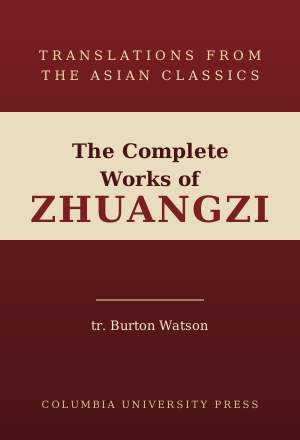
- Title
- The Complete Works of Zhuangzi (Translations from the Asian Classics)
- Author
- Zhuangzi, tr. Burton Watson
- Publisher
- Columbia University Press, 2013 (translation first published 1968)
- Length
- Complete translation · 368 pp.
- Difficulty
- Intermediate ★★☆ — long, but never obscure
Check price & availability on Amazon / Kindle edition available
What it is — in three lines
Burton Watson was one of the great translators of classical Chinese and Japanese, and his Zhuangzi has been the standard readable English version for half a century. This Columbia edition is the complete text — the seven Inner Chapters, the fifteen Outer Chapters, and the eleven Miscellaneous Chapters — updated so that names appear in the pinyin romanization now used by scholars. It comes with a compact introduction that sets the historical scene without turning the book into a seminar.
The core — all thirty-three chapters
The Inner Chapters give you Zhuangzi's central moves — free and easy wandering, the equality of things — but the rest of the book is where those ideas are stretched, tested, and sometimes argued against by later hands. Reading the whole thing, you feel the Zhuangzi as it really is: not a single treatise but a two-thousand-year-old anthology of a school, full of dialogues, jokes, craftsmen, and cooks.
The cook's blade stays sharp for years because he lets it move through the natural openings in the ox, never forcing it against bone — skill that has become a kind of ease.
— the parable of the skilful cook, "The Secret of Caring for Life" (editorial paraphrase, not Watson's wording)
Watson's gift is that this range never becomes a slog. His English is plain and quick, and the famous set-pieces — the cook cutting up the ox, the debate about the happiness of fish — land with their humor intact.
Three highlights
1. Readable from cover to cover
Of the complete translations, this is the one you can actually read straight through. That alone makes it the right first complete Zhuangzi.
2. The whole anthology
You meet the Outer and Miscellaneous Chapters, not just the famous seven — which is where much of the book's strangeness and variety lives.
3. A trusted hand
Watson's translations are a benchmark across the Asian classics; the introduction and light notes give you what you need without overwhelming the text.
What to watch out for
Two honest notes. First, it is a reading translation, not a scholarly apparatus: the notes are light, and where the Chinese is genuinely disputed Watson gives you a clear English line rather than a discussion of the alternatives. Readers who want to argue over the hard cruxes should pair it with Ziporyn's annotated Complete Writings or Graham's reconstruction. Second, the Outer and Miscellaneous Chapters are uneven — some are brilliant, some are later padding — so if the energy flags in the middle, it is the text, not you; skim to the next good story and press on.
Check price & availability on the Amazon product page