Home › Top 5 › The Inner Chapters
Review: Chuang-Tzu — The Inner Chapters — the scholar's benchmark
★★★★☆4.4 / 5.0 (editorial rating)
Verdict: the study edition, and a landmark. A. C. Graham, one of the great modern translators of classical Chinese, did not simply render the text — he reconstructed it, reorganizing the material around the distinct philosophical viewpoints he detected in it rather than following the received chapter order. The result is demanding and controversial and, for anyone who wants to think hard about what Zhuangzi actually argues, indispensable. It closes this shelf because it is where the reading turns into real study.
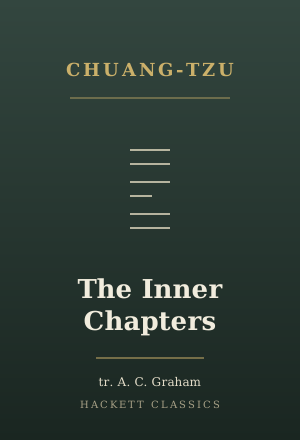
- Title
- Chuang-Tzu: The Inner Chapters
- Author
- Zhuangzi (Chuang-Tzu), tr. A. C. Graham
- Publisher
- Hackett Classics (translation first published 1981)
- Length
- Scholarly translation & reconstruction · ~293 pp.
- Difficulty
- Advanced ★★★ — a scholar's edition, and it shows
Check price & availability on Amazon / Kindle edition available
What it is — in three lines
Angus Graham was among the twentieth century's finest scholars of early Chinese thought, and this translation — despite its title — includes much more than the seven Inner Chapters: about four-fifths of the whole book, sorted by Graham into the strands he argued were the work of Zhuangzi himself, of his school, and of later, distinct hands. It is the only major English Chuang-Tzu organized around the philosophy rather than the traditional sequence, and it comes with the textual arguments to justify every move.
The core — a text taken apart and rebuilt
Graham's premise is that the received Zhuangzi is a composite, and that reading it in order can blur genuinely different voices together. So he separates them, and in doing so throws the sharpest passages — the argument about the limits of language and knowing, the vertigo of the butterfly dream — into unusually clear relief. You are reading not just a translation but a scholar's case about what the book is.
Words are not just wind — they are meant to say something; yet what they fix as "so" and "not so" keeps shifting, until you wonder whether anything has really been said at all.
— on the limits of "this" and "that," Inner Chapters (editorial paraphrase, not Graham's wording)
For the reader who has met Zhuangzi whole in Watson and wants to press on the joints of the argument, Graham is the sharpest tool available.
Three highlights
1. Philosophy first
The organization by viewpoint makes the intellectual structure of the book visible in a way no straight translation can.
2. Scholarly honesty on the seams
Graham shows his working — what he thinks is early, what is late, where the text is corrupt — so you always know when you are on solid ground and when you are on his reconstruction.
3. A translator of the first rank
The English is spare and exact; Graham's ear for a hard Chinese sentence is part of why the edition remains a benchmark decades on.
What to watch out for
The honest caution is the same as its virtue: this is a reconstruction, not a plain reading text. Because Graham reorders the material and interleaves his textual arguments, a first-time reader can lose the thread of the book as most editions present it. Do not start here, and do not treat the sequence as "the" Zhuangzi — it is Graham's considered hypothesis about the Zhuangzi, clearly labeled as such. Come after Watson (for the standard order) or Ziporyn's complete edition, and Graham becomes what it is meant to be: the sharpest instrument on the shelf for study rather than first acquaintance.
Check price & availability on the Amazon product page