Review: Philosophical Investigations — the late reversal and the language-game
★★★★★4.6 / 5.0 (editorial rating)
Verdict: the late masterwork, and the book in which Wittgenstein turns against his own Tractatus. Meaning is not a picture but a use; language is a family of "games" embedded in ways of living. It is written as hundreds of short, dialogue-like remarks rather than a treatise — the greatest work of twentieth-century philosophy of language, and best read after you have felt what it overturns. This 4th edition is the one to own.
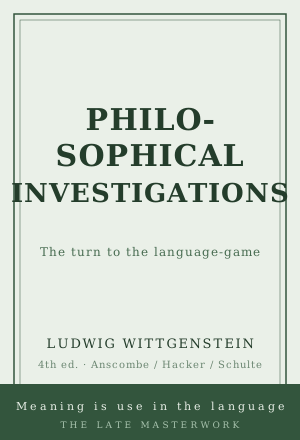
- Title
- Philosophical Investigations (4th edition)
- Author
- Ludwig Wittgenstein, tr. G. E. M. Anscombe, P. M. S. Hacker & Joachim Schulte
- Publisher
- Wiley-Blackwell (original: 1953) · German–English facing pages
- Length
- Primary source · ~320 pp.
- Difficulty
- Advanced ★★★ — accessible sentences, demanding argument
Check price & availability on the Amazon product page
What it is — in three lines
Published two years after Wittgenstein's death, this is the central text of his late philosophy. In numbered remarks — often a few lines each, frequently in the voice of an imagined interlocutor — he dismantles the idea that words get their meaning by naming things or picturing facts, and replaces it with a view of language as activity: countless "language-games" learned and played within forms of life. This definitive edition sets the revised Anscombe translation, edited by Hacker and Schulte, against the German on facing pages.
The reversal, in one view
The Tractatus asked what language must be for it to picture the world. The Investigations asks what we actually do with words — and finds no single essence, only a family of uses. Don't look for the meaning; look at the use.
— the editorial room's one-line map
This is the great about-face in modern philosophy. The same man who once sought the hidden logical form of language now warns against the very craving for hidden essences — the philosopher's disease, he says, is to look for something behind ordinary use. Because you arrive here having read the Tractatus, the reversal is not an abstraction; it is a position you watched him hold, being taken apart by its own author.
Three highlights
1. Meaning as use, and the language-game
The book's beating heart: to know what a word means is to know how to use it in the practices where it lives. The "language-game" is his tool for seeing this — small, describable activities (giving orders, reporting, joking, counting) in which words do real work.
For a large class of cases, the meaning of a word is its use in the language.
— Philosophical Investigations §43 (editorial gloss of the German)
2. Family resemblance
Why do we call so many different things "games" when no single feature is common to all? Because they share overlapping likenesses, like the members of a family — not one essence but a web of resemblances. It quietly dissolves a problem philosophy had chased since Plato.
3. The private-language remarks and rule-following
The later stretches — whether a purely private, uncheckable language is possible, and what it is to "follow a rule" — are among the most discussed passages in all analytic philosophy. They are hard, and they are worth every hour.
What to watch out for
Honestly: the sentences are easy and the book is not. Each remark reads plainly, but the argument advances sideways — by example, question and imagined objection — so you can finish a page and not know what was proved. Two defences. First, come after the Tractatus; the whole shelf is built so that you feel the reversal instead of merely reading about it. Second, read it as a conversation, not a proof: sit with a remark, supply your own examples, let the interlocutor's voice be genuinely tempting before Wittgenstein answers it. One governing note: this is the late Wittgenstein, deliberately at odds with the early one — keep the two apart and each becomes sharper.
Check price & availability on the Amazon product page