Home › Top 5 › The Duty of Genius
Review: Ludwig Wittgenstein: The Duty of Genius — the life behind the two philosophies
★★★★★4.8 / 5.0 (editorial rating)
Verdict: the finish line of the shelf, and a great biography by any measure. Ray Monk threads the man and the work into a single narrative — the fortune renounced, the war, the village schoolteaching, the return to Cambridge — so that the early and late philosophies stop being two disembodied systems and become moves in one life. Read it after the masterworks and the reversal finally has a person around it.
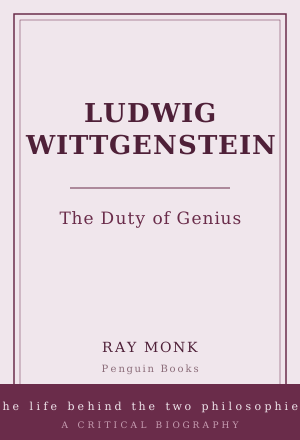
- Title
- Ludwig Wittgenstein: The Duty of Genius
- Author
- Ray Monk
- Publisher
- Penguin Books (first published 1990)
- Length
- Biography · ~700 pp.
- Difficulty
- Intermediate ★★☆ — long, but reads like a novel
Check price & availability on the Amazon product page / Kindle edition available
What it is — in three lines
The standard modern life of Wittgenstein, and a rare thing: a biography by a philosopher who takes the philosophy as seriously as the life, and a storyteller who makes 700 pages fly. Monk follows Wittgenstein from wealthy Vienna through Cambridge, the trenches of the First World War, the writing of the Tractatus, the abandonment of philosophy for a village classroom, and the long return that produced the Investigations. It won the Duff Cooper Prize and has been the go-to life since it appeared.
Why read it last
An introduction gives you the map; the masterworks give you the terrain; the biography gives you the traveller. Come here last and the reversal reads not as a puzzle but as something a particular man had to do.
— the editorial room's one-line case
Monk's governing idea — caught in the title — is that for Wittgenstein philosophy was an ethical demand, a duty owed to one's own honesty, not an academic career. That thread makes sense of the strangest facts of the life: giving away a fortune, breaking off philosophy at the height of his fame, going back to first questions in his fifties. After the primary texts, this is where the early and the late finally cohere into a single, driven human project.
Three highlights
1. Philosophy woven into life
Monk moves between biography and exposition without a seam, pausing to explain the picture theory or the language-game exactly where the life reaches them. It is the best demonstration on this shelf of how the two philosophies actually connect.
2. The war and the Tractatus
The chapters on Wittgenstein writing the Tractatus as a soldier — often under fire — are unforgettable, and they change how the book's closing pages on ethics and the mystical read.
3. Simply a great story, well told
The renounced inheritance, the schoolteaching years, the friendships and torments: Monk's narrative gift keeps a very long book moving, and sends most readers straight back to the philosophy with new energy.
What to watch out for
Two honest notes. First, it is a biography, not a commentary. The philosophical exposition is excellent for a general reader but necessarily brisk; it complements the primary texts rather than replacing the work of reading them — which is why it sits last, after the Tractatus and the Investigations. Second, every biography is an interpretation. Monk's "duty of genius" framing is powerful and widely admired, but it is a reading of the life, and some scholars would weight the man's motives differently — take it as the finest single narrative, not the only possible one. At ~700 pages it also asks for real time; the length is the price of its completeness.
Check price & availability on the Amazon product page