Home › Top 5 › Blue and Brown Books
Review: The Blue and Brown Books — the late thinking, spoken aloud
★★★★☆4.2 / 5.0 (editorial rating)
Verdict: the bridge between the two Wittgensteins. Dictated to his Cambridge students in the years when the early system was giving way to the late one, these notes let you hear the ideas that become the "language-game" and "family resemblance" while they are still being spoken — before they hardened into the compressed remarks of the Investigations. The gentlest on-ramp to the late thought.
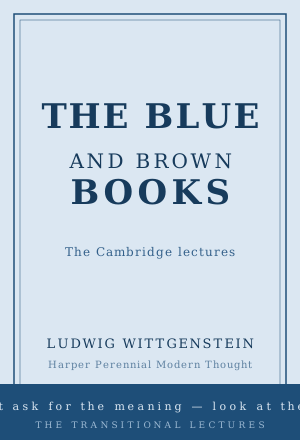
- Title
- The Blue and Brown Books
- Author
- Ludwig Wittgenstein
- Publisher
- Harper Perennial Modern Thought (dictated 1933–35)
- Length
- Lectures / dictated notes · ~208 pp.
- Difficulty
- Intermediate ★★☆ — plain-spoken, but genuine philosophy
Check price & availability on the Amazon product page
What it is — in three lines
Two sets of notes Wittgenstein dictated to students at Cambridge in the mid-1930s, named for the colour of the wrappers they were bound in. The "Blue Book" opens with the question "What is the meaning of a word?" and moves toward looking at use rather than hunting for essences; the "Brown Book" works through long series of imagined simple languages. Together they are a draft workshop for what became the Philosophical Investigations — the late thinking caught in mid-formation.
Why the transition matters
Read the Investigations and you meet conclusions in fragments. Read the Blue and Brown Books and you watch the same conclusions being reached — the argument still has its working shown.
— the editorial room's one-line case
The great difficulty of the late masterwork is its compression: remarks that assume the road already travelled. These lectures travel that road out loud. Because they were spoken to students who needed to follow in real time, they are more continuous in flow, more patient with examples, and far easier to hold in the mind. For a reader thrown by the Investigations, this is where the late method becomes legible.
Three highlights
1. "Don't look for the meaning, look at the use" — worked slowly
The Blue Book's opening pages take apart the assumption that a word must stand for a thing, and do it at a pace a beginner can follow. It is the clearest short statement of the move that defines the late philosophy.
2. The invented "languages" of the Brown Book
Long sequences of tiny, made-up languages — builders calling for blocks, and so on — show the "language-game" method in action rather than in definition. Some readers find them dry; used as exercises, they are the best training available for how Wittgenstein thinks.
3. The living voice
Because it is dictation, the prose keeps the rhythm of a teacher thinking on his feet — asides, second thoughts, direct address. It is the most human-sounding of his texts, and that voice is exactly what makes the ideas stick.
What to watch out for
Two honest notes. First, these are drafts, not a finished book. Wittgenstein never authorised them for publication; there are loose ends and passages he later reworked or dropped. Read them as scaffolding for the Investigations, not as a rival to it. Second, the Brown Book's long language-drills can feel monotonous if you read them as prose to be finished rather than exercises to be done — go slowly, build the little languages in your head, and the point arrives. One governing note: this is transitional late Wittgenstein — helpful precisely because it sits between the two positions, but not itself either the early system or the mature late statement.
Check price & availability on the Amazon product page