Home › Top 5 › Very Short Introduction
Review: Wittgenstein: A Very Short Introduction — the whole career, in one short book
★★★★☆4.4 / 5.0 (editorial rating)
Verdict: the best place to begin. In about a hundred and sixty pages Grayling lays out both the early and the late philosophy and, above all, why Wittgenstein turned against his own first book — the reversal that defeats readers who open the masterworks cold. Get this map, and the Tractatus and the Investigations stop being a wall and become a route.
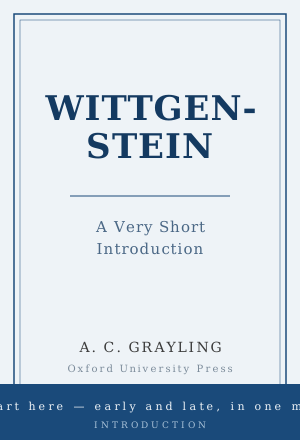
- Title
- Wittgenstein: A Very Short Introduction
- Author
- A. C. Grayling
- Publisher
- Oxford University Press (Very Short Introductions series)
- Length
- Introduction · ~160 pp.
- Difficulty
- Beginner ★☆☆ — written for the general reader
Check price & availability on the Amazon product page / Kindle edition available
What it is — in three lines
A short, single-author survey of Wittgenstein's life and thought in Oxford's Very Short Introductions series. Grayling — a philosopher and a fluent popular writer — covers the early Tractatus, the break, and the late Philosophical Investigations, keeping the technical vocabulary to a minimum. It is a map, not a commentary: designed to orient you before you open the primary texts.
Why an introduction first
Meet the two Wittgensteins on paper before you meet either in the original. Know that the early book ends in silence and the late book begins again from ordinary language — and you will never mistake one for the other.
— the editorial room's one-line case
Wittgenstein is unusually dangerous to read blind, because the same author holds opposite positions. Start in the Tractatus with no bearings and its numbered propositions read like a locked door; start in the Investigations and its scattered remarks feel like a notebook you weren't meant to see. An introduction that shows you the shape of the whole career — and the hinge between the halves — is what turns both into books you can actually climb.
Three highlights
1. Both philosophies, in proportion
Many short accounts rush the early book to get to the fashionable late one. Grayling gives each its due, and — this is the point — makes the relationship between them the spine of the story. You come away knowing not just what he thought at each stage but why the second stage had to reject the first.
2. Plain about the hard ideas
The picture theory, the saying/showing distinction, the language-game, family resemblance: the load-bearing ideas are explained in ordinary words, with just enough example to make them stick. It is the kind of clarity that only a writer who has fully digested the material can manage.
3. A genuine "first book"
Short enough to read in an afternoon, cheap, and everywhere in print — the practical virtues of a real starting point. You are not committing a fortnight before you know whether Wittgenstein is for you.
What to watch out for
Two honest notes. First, Grayling's reading is his own. Wittgenstein scholarship is famously contested, and some specialists would frame the early book, or the relation between saying and showing, differently; treat this as one clear, well-argued route in, not the last word. Second, an introduction is scaffolding, not the building. It cannot substitute for the experience of the propositions and remarks themselves — its job is to get you to them without flinching, and it does that job well. Read it, then move to the Tractatus.
Check price & availability on the Amazon product page