Home › Top 5 › The Last Days of Socrates
Review: The Last Days of Socrates — philosophy begins in this courtroom
★★★★☆4.4 / 5.0 (editorial rating)
Verdict: the first book on Socrates, with almost nothing to argue about. One paperback, a courtroom drama, and the source of Western philosophy — that combination barely exists anywhere else in the canon. Read what "the unexamined life is not worth living" actually cost the man who said it, not as a summary, but from a seat in the jury.
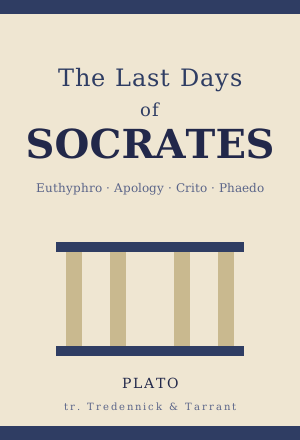
- Title
- The Last Days of Socrates (Euthyphro, Apology, Crito, Phaedo)
- Author
- Plato, tr. Hugh Tredennick & Harold Tarrant
- Publisher
- Penguin Classics (originals: 4th century BC)
- Length
- Primary source · ~250 pp. (four dialogues + apparatus)
- Difficulty
- Beginner ★☆☆ — the Apology reads in an afternoon
Check price & availability on the Amazon product page
What it is — in three lines
In 399 BC a seventy-year-old Socrates was prosecuted for impiety and "corrupting the young," and defended himself before a jury of hundreds of his fellow Athenians. Plato's Apology recreates that defence speech; this Penguin volume sets it among three companion dialogues — Euthyphro (just before the trial), Crito (in prison, refusing to escape) and Phaedo (the day of the execution). Less a treatise than a piece of courtroom theatre — from which all of Western philosophy then flows.
Why it can be your first original
The reason is the form. There is no system here and almost no jargon — only the voice of one man defending "the love of wisdom" with his life on the line. The famous investigation, framed as Socrates unravelling the Delphic oracle that "no one is wiser than Socrates" — questioning politicians, poets and craftsmen and finding that each thinks he knows what he does not — is the original context of what everyone now calls "knowing that you know nothing."
I am wiser than this man; for neither of us really knows anything fine and good, but he thinks he knows when he does not, while I neither know nor think I know.
— Plato, Apology 21d (editorial gloss of the Greek)
You can read it straight through like a story, yet you close it holding a question about what it means to live an examined life. For a philosophical original, that ratio of readability to importance is almost unheard of.
Three highlights
1. The oracle story — "knowing that you know nothing," on site
The famous idea turns out not to be a motto of modesty but the report of a one-man field survey that made enemies across the whole city. Reading it in context does more for your understanding than several introductions could.
2. The counter-penalty
After the guilty verdict, where custom invited a defendant to propose exile or a fine, Socrates opens by suggesting the city should instead reward him with free meals at public expense. Insolent, or magnificent — either way it is the dramatic peak of the speech.
3. The closing view of death
"To fear death is only to think oneself wise when one is not" — the defence dissolves even the fear of death with the same move, and lands squarely on a reader twenty-four centuries later. It is also the seed of the Phaedo.
To fear death is nothing other than to think oneself wise when one is not; for it is to think one knows what one does not know.
— Plato, Apology 29a (editorial gloss of the Greek)
What to watch out for
Two honest notes. First — and this governs the whole site — this is Plato's Socrates. Socrates wrote nothing; the man in this book is a literary character reconstructed (and partly authored) by his most gifted pupil, and the distance between that portrait and the historical man is a real scholarly problem. Taylor's Very Short Introduction takes it on directly. Second, this volume already contains the Phaedo, whose later arguments are much harder going than the Apology; do not be surprised by the change of gear, and feel free to read the four dialogues in trial-to-death order rather than the order printed.
Check price & availability on the Amazon product page