Home › Top 5 › Very Short Introduction
Review: Socrates: A Very Short Introduction — the scholar's map to a man who wrote nothing
★★★★☆4.2 / 5.0 (editorial rating)
Verdict: read this after the dialogues, and the fog lifts. When the Apology leaves you asking "so who was this man, and how do we know any of it?", Taylor answers with the discipline of an Oxford ancient philosopher: the sources, "the Socratic problem," and what the questioning really amounts to, in about a hundred and sixty pages that never waste one.
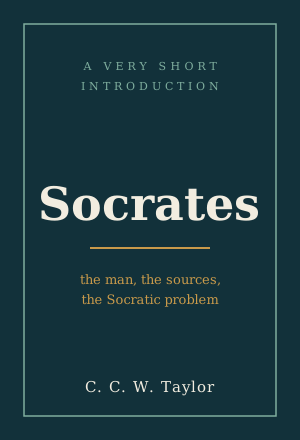
- Title
- Socrates: A Very Short Introduction
- Author
- C. C. W. Taylor (ancient philosophy, University of Oxford)
- Publisher
- Oxford University Press (2nd ed., 2019)
- Length
- ~160 pp.
- Difficulty
- Intermediate ★★☆ — about four hours
Check price & availability on the Amazon product page
What it is — in three lines
A short scholarly introduction to Socrates by C. C. W. Taylor, a distinguished Oxford ancient philosopher, in Oxford's Very Short Introductions series (this second edition, 2019). Not a retelling of the trial but a working map: the historical setting, the competing sources, and a careful account of Socratic method and ethics. Short, but genuinely a piece of scholarship, not a summary of one.
The core — "the Socratic problem"
Because Socrates wrote nothing, everything runs through witnesses who disagree: Plato's philosophical Socrates, Xenophon's more homely one, Aristophanes' comic caricature, and Aristotle's later testimony. Which of them, if any, gives us the man? This is "the Socratic problem," and Taylor's clear-eyed handling of it is the book's centre of gravity. He does not pretend it away or resolve it by fiat; he shows you what can and cannot responsibly be claimed, and why the early Platonic dialogues are usually treated as the best available window.
I am the wisest, since I at least know that I know nothing.
— the popular formula; Taylor traces it to Apology 21b–23b, where Socrates' point is subtler (editorial gloss)
That is the value of the book: the slogan you arrived with gets examined, and you leave holding the actual argument instead.
Three highlights
1. The sources, weighed
Plato, Xenophon, Aristophanes, Aristotle — Taylor sets each witness on the scale and tells you what it can bear. After this chapter you will never again read "Socrates said" without hearing the quieter question, "according to whom?"
2. Method and ethics, made precise
What the elenchus (the question-and-refutation method) is actually doing, and why Socrates held the striking view that no one does wrong willingly, are laid out with a philosopher's precision — the substance the dialogues dramatize but do not spell out.
3. Brevity without shallowness
The series format forces economy, and Taylor turns the constraint into a virtue: no padding, no anecdote for its own sake, every page carrying argument. It is the rare short book that a specialist can also respect.
What to watch out for
Two honest notes. First, this is not a first book. Its concision assumes you already have a scene in your head; open it before the Apology and the compression will feel dry. Read the dialogue first, this second. Second, it is deliberately a map, not a story: if you want narrative colour and a vivid young Socrates, that is the job of Socrates in Love — Taylor gives you the framework, D'Angour the flesh.
Check price & availability on the Amazon product page