Home › Top 5 › Introducing Plato
Review: Introducing Plato: A Graphic Guide — the illustrated way in to Socrates
★★★★☆3.8 / 5.0 (editorial rating)
Verdict: the honest accessible entry, chosen with a caveat we will not hide. There is no English "manga of the Apology," so this illustrated guide fills that slot — and it earns the place, because you cannot separate Socrates from Plato: nearly everything we know of the teacher comes through the pupil. One idea per drawn-and-captioned spread, in about an hour. For anyone who wants the whole picture mapped before facing prose.
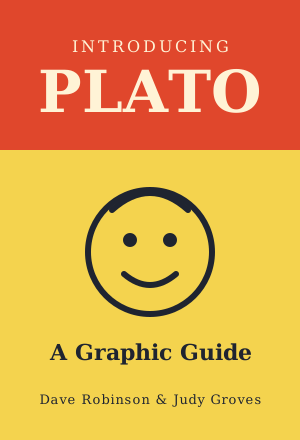
- Title
- Introducing Plato: A Graphic Guide
- Author
- Dave Robinson (text), Judy Groves (illustrations)
- Publisher
- Icon Books (Graphic Guide series)
- Length
- 176 pp.
- Difficulty
- Beginner ★☆☆ — about one hour
Check price & availability on the Amazon product page
What it is — in three lines
Icon Books' long-running Graphic Guide on Plato: his life, the shadow of Socrates over it, and the whole vocabulary — the theory of Forms, the Socratic method, the just city of the Republic — one idea per illustrated spread. Text by Dave Robinson, drawings by Judy Groves. Read in an hour, kept as a reference card for years. It is a guide to Plato, and we shelve it here deliberately, because that is where the accessible Socrates lives.
Why a guide to Plato is the way in to Socrates
Let us be plain about the swap. The Japanese edition of this shelf can open with a manga of the Apology; no equivalent exists in English. Rather than invent one, we chose the best genuine illustrated entry — and it turns out to fit the subject exactly, because Socrates is inseparable from Plato. The dialogues are our main source; the early ones are widely read as the closest thing to the historical Socrates; the middle ones put Plato's own philosophy in Socrates' mouth. To see that whole structure drawn — where "Socrates" ends and "Plato" begins — is precisely the map a beginner needs.
The unexamined life is not worth living for a human being.
— Plato, Apology 38a (standard rendering)
A guide that shows you that line's place in Plato's whole project does more than decorate it. Each spread plants an image, the caption supplies the claim, and the map builds itself.
Three highlights
1. The Socrates–Plato boundary, made visible
The single most useful thing a beginner can learn is where the historical Socrates plausibly ends and Plato's own doctrine begins. Laid out as a sequence of spreads, that distinction — which trips up even careful readers — finally sits still long enough to grasp.
2. The Socratic method, in pictures
Watching Socrates dismantle a confident claim with nothing but questions suits the comic format perfectly: philosophy stops looking like difficult doctrine and starts looking like a technique of conversation you could try yourself.
3. It takes the ideas seriously
The format is playful; the text is not dumbed down. Robinson flags the genuinely contested points — how much of the "Socrates" of the dialogues is historical, what the Forms are really meant to explain — instead of flattening them.
What to watch out for
Plainly: this is scaffolding, not the building — and it is a guide to Plato, not a book about Socrates alone. You will not have read Socrates when you finish; you will be equipped to. And because so much of the volume is Plato's later philosophy, keep hold of the boundary it draws: the vivid, questioning figure of the early dialogues is the one closest to the man on trial. For the man himself, in his own defence, go to The Last Days of Socrates; for the scholarship on how much of him we can actually recover, to Taylor.
Check price & availability on the Amazon product page