Home › Top 5 › The Wisdom of Life
Review: The Wisdom of Life and Counsels and Maxims — not how to be happy, but how to be less unhappy
★★★★★4.3 / 5.0 (editorial rating)
Verdict: the most immediately usable book Schopenhauer wrote, and the natural second or third step. His famous practical philosophy — the "Aphorisms on the Wisdom of Life" — complete in the classic Saunders translation. For anyone tired of addition-based self-help: this is the subtraction school, from its founder.
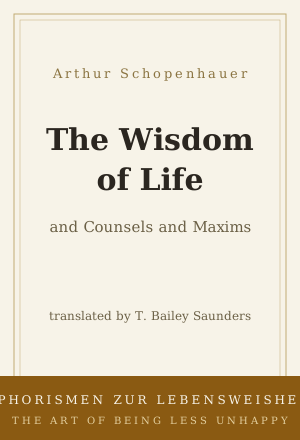
- Title
- The Wisdom of Life and Counsels and Maxims (Great Books in Philosophy)
- Author
- Arthur Schopenhauer, tr. T. Bailey Saunders
- Publisher
- Prometheus Books (1995)
- Length
- ~230 pp.
- Difficulty
- Intermediate ★★☆ — nineteenth-century prose, worldly subject matter
Check price & availability on the Amazon product page
What it is — in three lines
The "Aphorisms on the Wisdom of Life" from Parerga and Paralipomena (1851): Schopenhauer's own practical guide to health, wealth, reputation, solitude and age. He designed it to be readable without the metaphysics — his own popular edition of himself. Two parts: The Wisdom of Life (the theory of happiness) and Counsels and Maxims (the rules of thumb).
The core: happiness is subtraction
To live happily means to live less unhappily — to live a tolerable life.
— Schopenhauer, "Aphorisms on the Wisdom of Life" (editorial gloss of the opening argument)
Not adding pleasures but subtracting pains. From this one inversion the whole book unspools: health outranks everything; fame lives in other people's heads and is therefore not yours; wealth is sea-water, the more you drink the thirstier you get. Every famous line traces back to the single principle — which is why 230 pages of aphorisms never feel scattered.
Three highlights
1. "What a man is" beats "what a man has"
The opening division — what you are, what you have, how you appear — and the argument that the first term dominates happiness, compresses a hundred self-help books into one chapter written in 1851.
2. The anatomy of reputation
Honor and fame exist only in the heads of others; to stake your peace on them is to hand strangers the keys. The vocabulary of "approval-seeking" did not exist yet; the complete diagnosis of it did.
3. The ages of life
The closing meditation on youth and age — each stage of life with its own season of the mind — is the old philosopher observing his own old age, and it reads warmer than anything else he wrote.
What to watch out for
Three honest notes. First, Saunders' Victorian translation is a classic but occasionally abridges; the "Counsels and Maxims" part in particular is a partial rendering, and the "Ages of Life" chapter may be absent from this edition — if completeness matters to you, the Cambridge Parerga Vol. 1 is the scholarly alternative. Second, the nineteenth-century examples (duels, salons, rank) can be skimmed; the arguments survive without them. Third, the notorious views on women that surface elsewhere in Schopenhauer are largely absent here, but read him always as a man of his century — separate the core from the period damage.
Check price & availability on the Amazon product page