Home › Top 5 › The World as Will and Representation
Review: The World as Will and Representation, Vol. 1 — read it last, but read it
★★★★★4.5 / 5.0 (editorial rating)
Verdict: the destination of this entire site — and strictly the last stop. The book that changed Nietzsche, Wagner and Freud, in the classic Payne translation at a Dover price. Arrive via the four books above and it reads as the complete version of a story you already know; buy it first and it will defeat you, as it has defeated generations of readers.
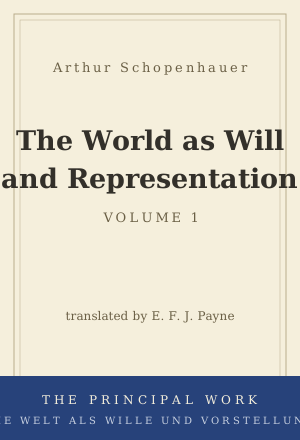
- Title
- The World as Will and Representation, Vol. 1
- Author
- Arthur Schopenhauer, tr. E. F. J. Payne
- Publisher
- Dover Publications (1966; translation 1958)
- Length
- ~575 pp.
- Difficulty
- Advanced ★★★ — Book One's Kantian vocabulary is the wall
Check price & availability on the Amazon product page
What it is — in three lines
The principal work, completed when Schopenhauer was thirty (1818). From the opening sentence — "The world is my representation" — it argues that the inner nature of the world is blind, striving will; that art grants temporary release from it; and that the only lasting exit is the will's denial. One thought, as he insisted, in one book.
A map of the four books
Book One: the world is representation (epistemology). Book Two: its inner nature is will (metaphysics). Book Three: art is a temporary truce with the will (aesthetics). Book Four: the denial of the will is the only exit (ethics).
— the editorial room's one-line map
Carry the map and the failure rate collapses. The choke point is Book One, where Kant's vocabulary falls like weather. If it stops you, skip to Book Two and return later — the heart of the philosophy beats from Book Two onward, and Book One reads far more easily once you know what it is preparing.
Three highlights
1. Book Two — the invention of the will
The argument runs from your own body — the one thing you know from inside — to the inner nature of everything. Desire, instinct, gravity itself gathered under one principle: among the grandest vistas philosophy offers, and the moment the book stops being difficult and starts being unputdownable.
2. Book Three — why music is different
The arts rank by how far they quiet the will, and music stands apart as the copy of the will itself. This is the passage that captured Wagner; readers who care about art can enter the book here and pay for the volume with Book Three alone.
3. Book Four — where everything converges
The life-wisdom maxims, the suicide essay's cold logic, the suffering-as-rule doctrine — every essay you read on the way here turns out to be a fragment of Book Four's account of affirming and denying the will. The reading order pays off in one long chapter.
Where readers stall — and the editions question
Two honest notes. First, the stall point is Book One's Kantian vocabulary; use the detour above, and if you want running commentary, our sister archive's section-by-section readings (139 articles, free, in Japanese) follow this very text §1–§71. Second, editions: Payne (Dover) is the long-standing standard and by far the best value; the Cambridge translation (Norman/Welchman/Janaway, ISBN 1107414776) is the newer scholarly rendering at a higher price. Either is sound — our advice is simply to start reading rather than to wait for the perfect edition. Beware of anonymous print-on-demand reprints of the same title; link and buy the Dover ISBN.
Check price & availability on the Amazon product page